
Chakaruna: the in-between being
On view until June 3, 2026
Venue: Galería Patricia Ready (Santiago de Chile, Chile)
Artist: Amalia Valdés
Curator: Vanina Saracino, IKT Member
We exist through our relationships: between ways of thinking, languages, territories, and modes of life that do not always coincide, yet intertwine, contaminate, and transform one another. It is within these spaces of transition, within this in-between, that displacements, encounters, and frictions emerge. From this same logic, the cosmos of Amalia Valdés takes shape as a symbolic and geometric system of its own, in which each element is articulated within a field of constantly shifting relations: a territory unfolding where worlds only seemingly opposed draw near and become mutually implicated.
Some people possess the capacity to inhabit the tension inherent to liminal spaces, to move between worlds, visions, and seemingly antagonistic realities. In Andean cosmologies, this figure is known as chakaruna (from the Quechua chaka, bridge, and runa, person): the bridge-being. More than a concept, it is a practice and a continuous process of learning in response to contexts that constantly mutate and evolve. What might this way of inhabiting the world teach us today?
In a context marked by increasingly acute political divisions, by the consequences of extractive models that have devastated territories and communities, and by a conception of nature as an external resource, Indigenous thought (historically marginalized by modern Western epistemology) offers a different perspective: relational, systemic, and deeply interdependent. Within this framework, the figure of the chakaruna acquires a particular historical significance: the possibility of building bridges, opening channels of understanding, and sustaining spaces of encounter between worlds that often remain separated. To be chakaruna, to inhabit the in-between, is not an innate gift but a condition that must be cultivated: it implies intention, listening, curiosity, respect, and empathy toward difference.
This exhibition proposes thinking of art as a privileged space for such a practice: a place where identities are not fixed nor meanings closed, but where connections are rehearsed. Valdés invites us to consider art as a potential territory of mediation, a practice capable of producing bridges across the multiple borders of the contemporary world, both tangible and subtle, yet equally present.
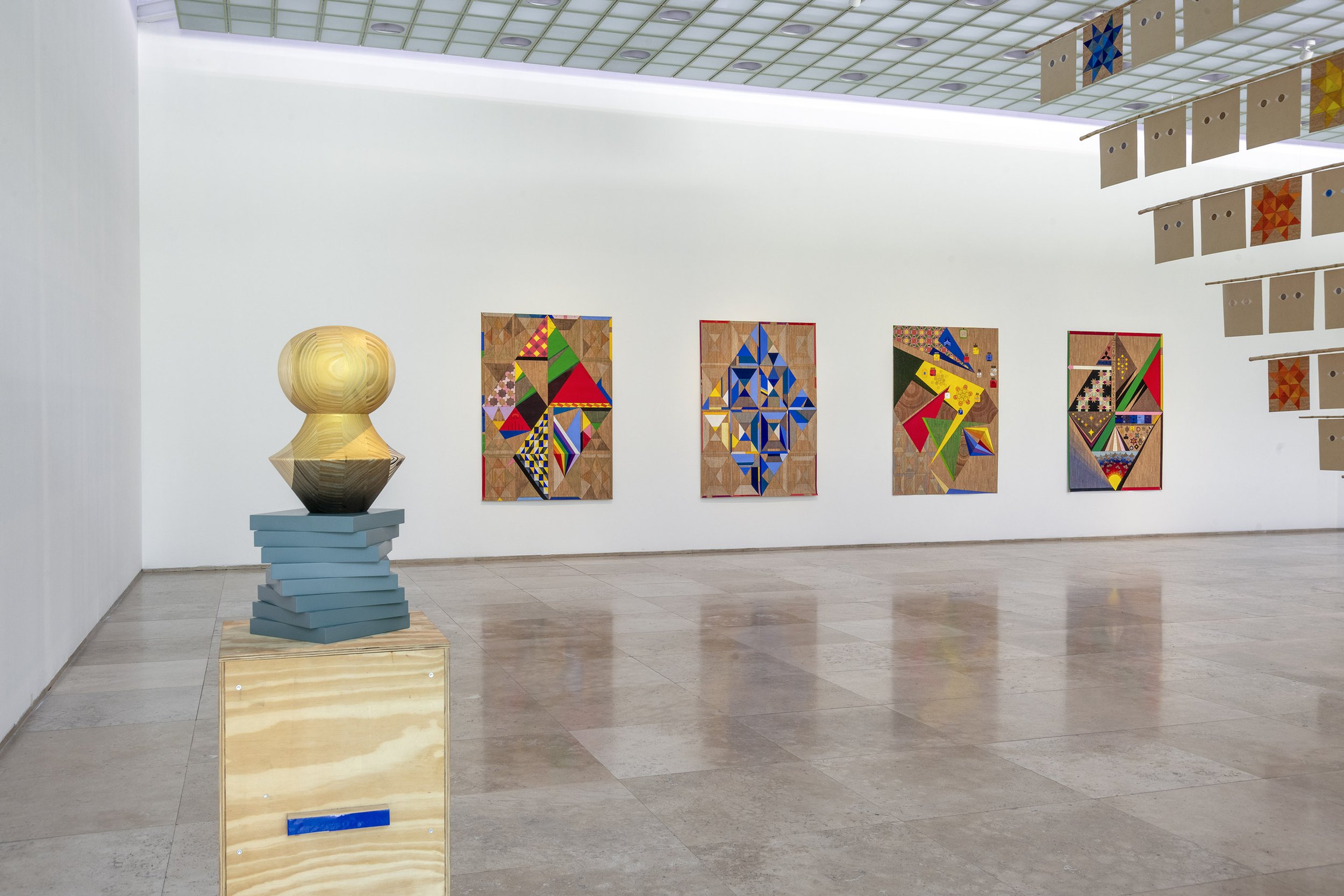
Through her sculptures, drawings, and paintings, the artist interweaves geometric and chromatic compositions that develop intuitively and associatively, without a strictly predetermined plan, giving rise to an autocosmology in which encounter operates as a principle. Symbols drawn from diverse references configure this universe: Andean cosmologies (such as the recurring Chakana) and Mayan traditions, mystical iconographies, emblems from Buddhism, Islamic traditions (such as the Hamsa), Hinduism, ancient Egypt, the Greco-Roman world, among others. Within this practice of relational appropriation, each symbol operates both as a vector that activates connections and as a unit within a transhistorical and transcultural alphabet: one of the many ways through which human societies have made sense of experience over time. Wood, cork, and paper become vibrant, living matter in which thought and form evolve in synchrony with process.
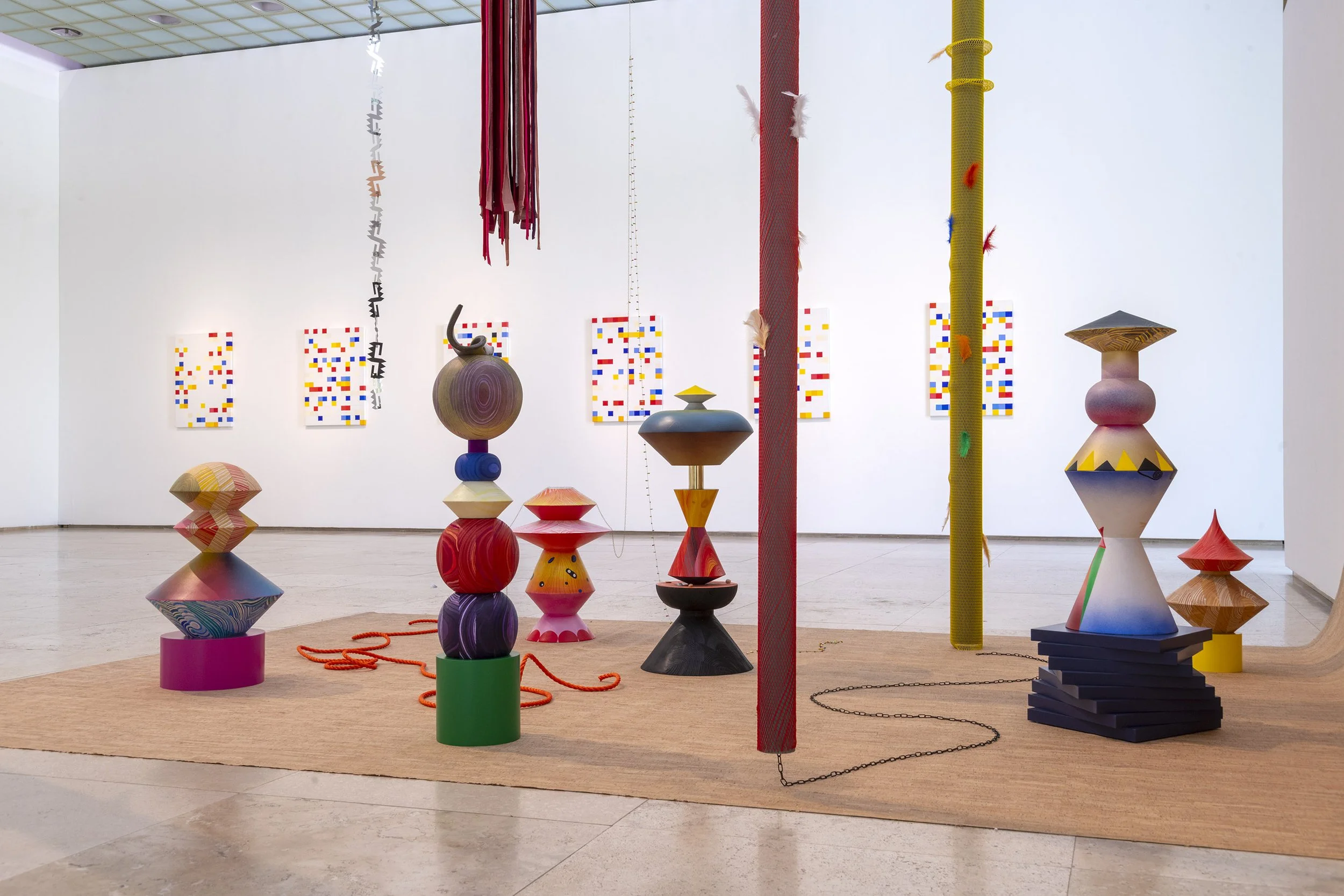
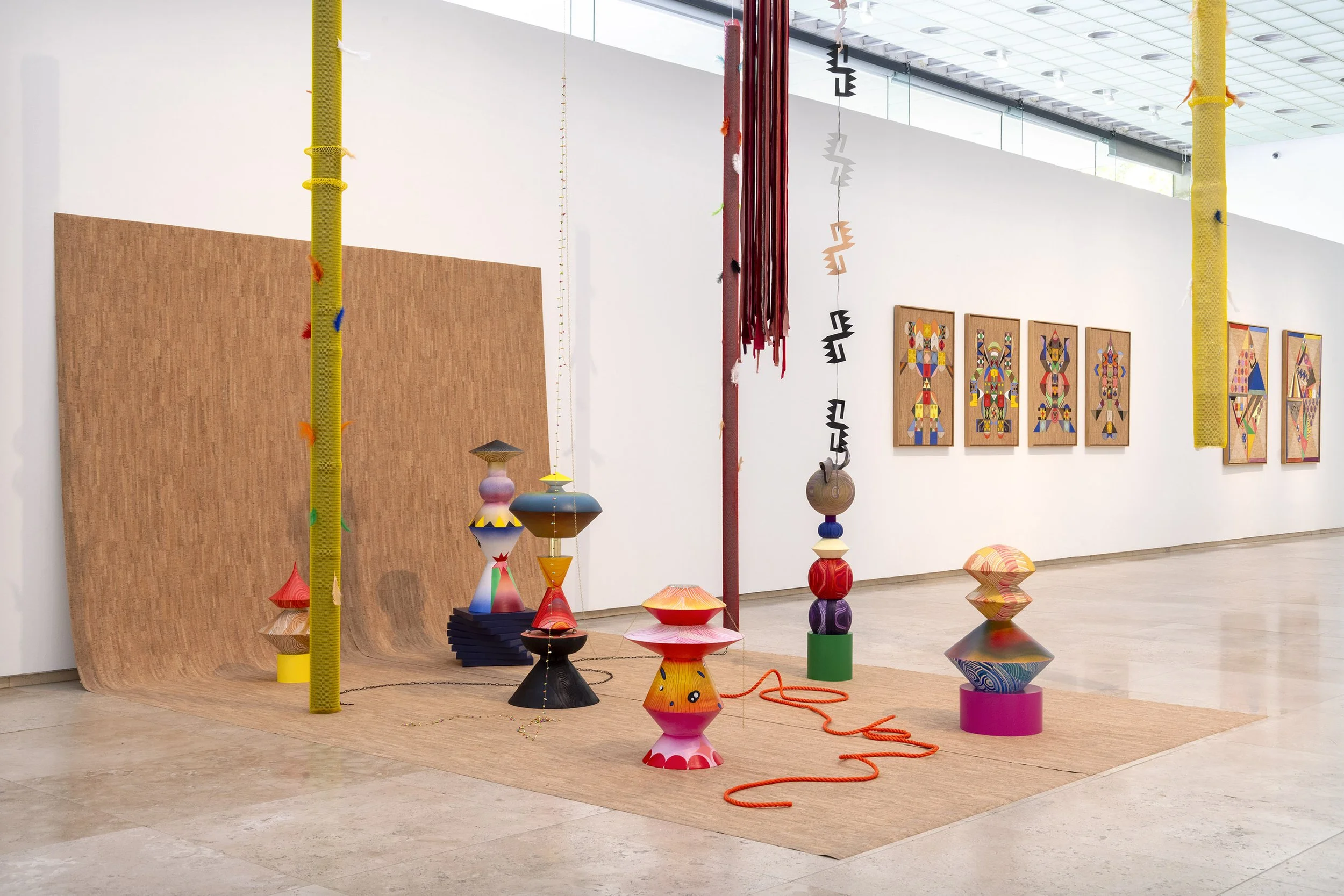
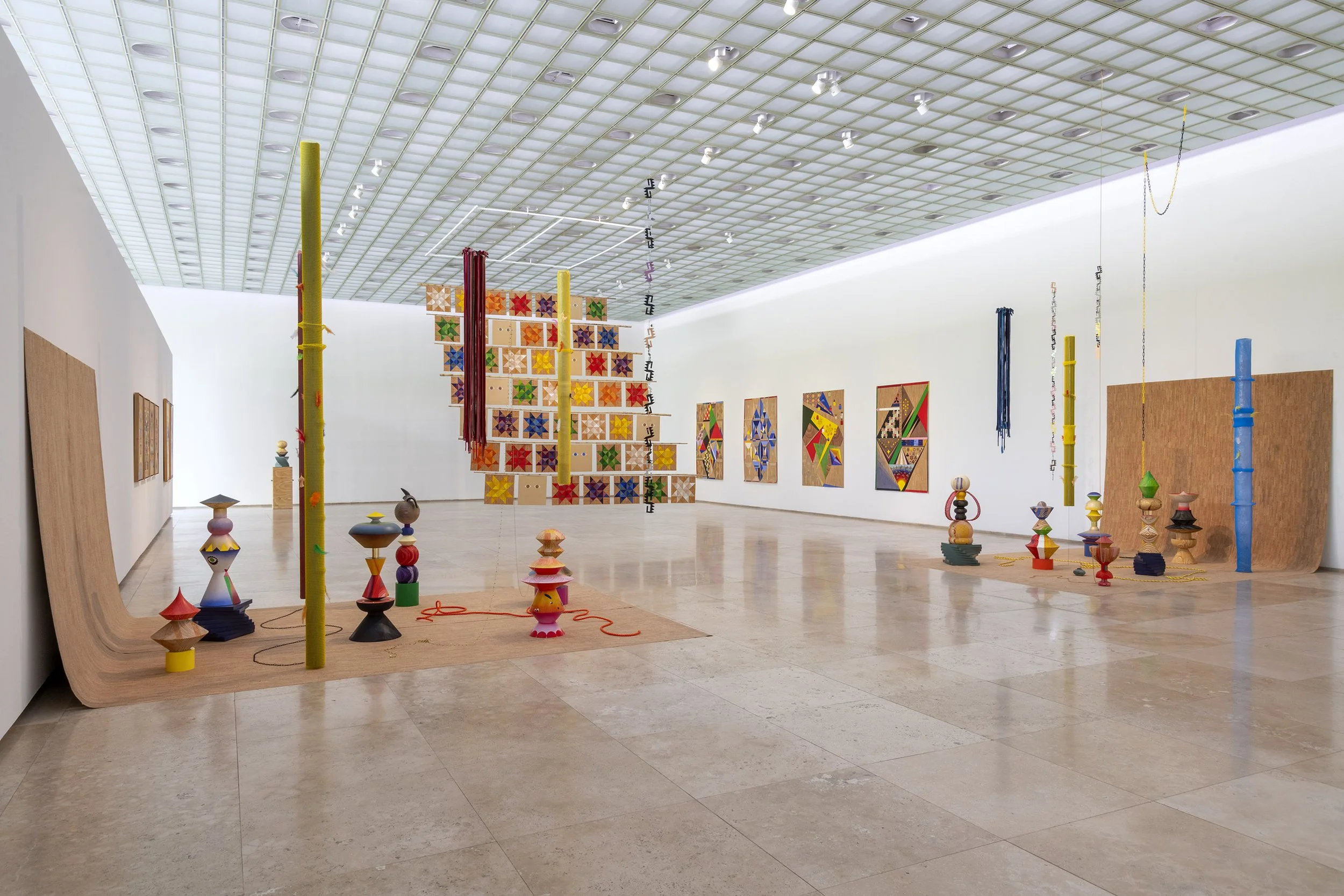
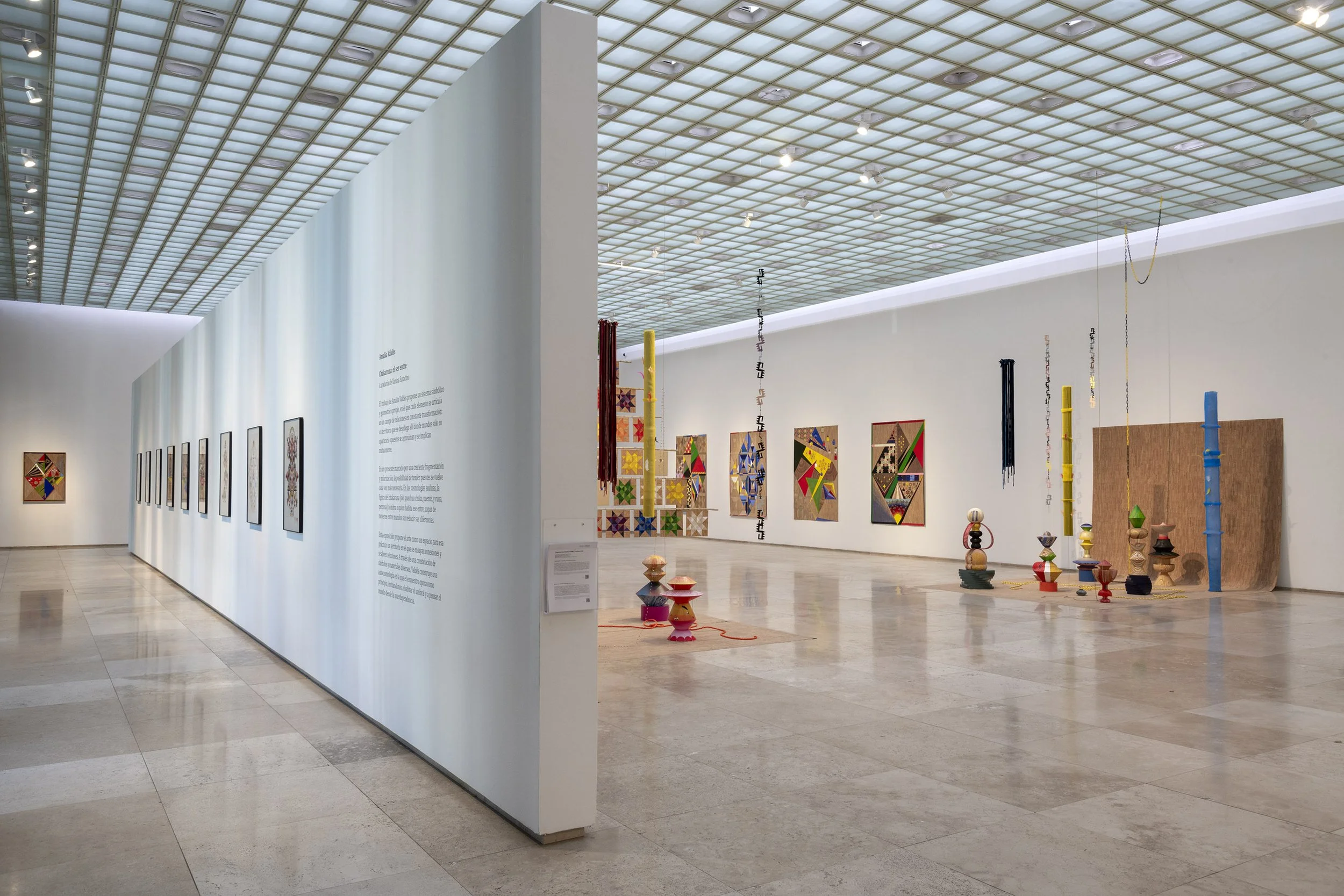
The exhibition unfolds as a metabolic journey, inviting us from the outset to pass through a cosmic portal. A group of sculptures in turned fir wood proposes a free reinterpretation of totemic forms, arranged in clusters on either side of the space, activating the coexistence of distinct yet potentially connectable worlds. Each figure, singularly painted and at times incorporating diverse materials, exists both as an individual entity and as part of a community. Vertical elements connect ceiling and floor, articulating relations between above and below and activating dynamics of exchange between worlds. Whoever crosses this liminal space is invited to become chakaruna.
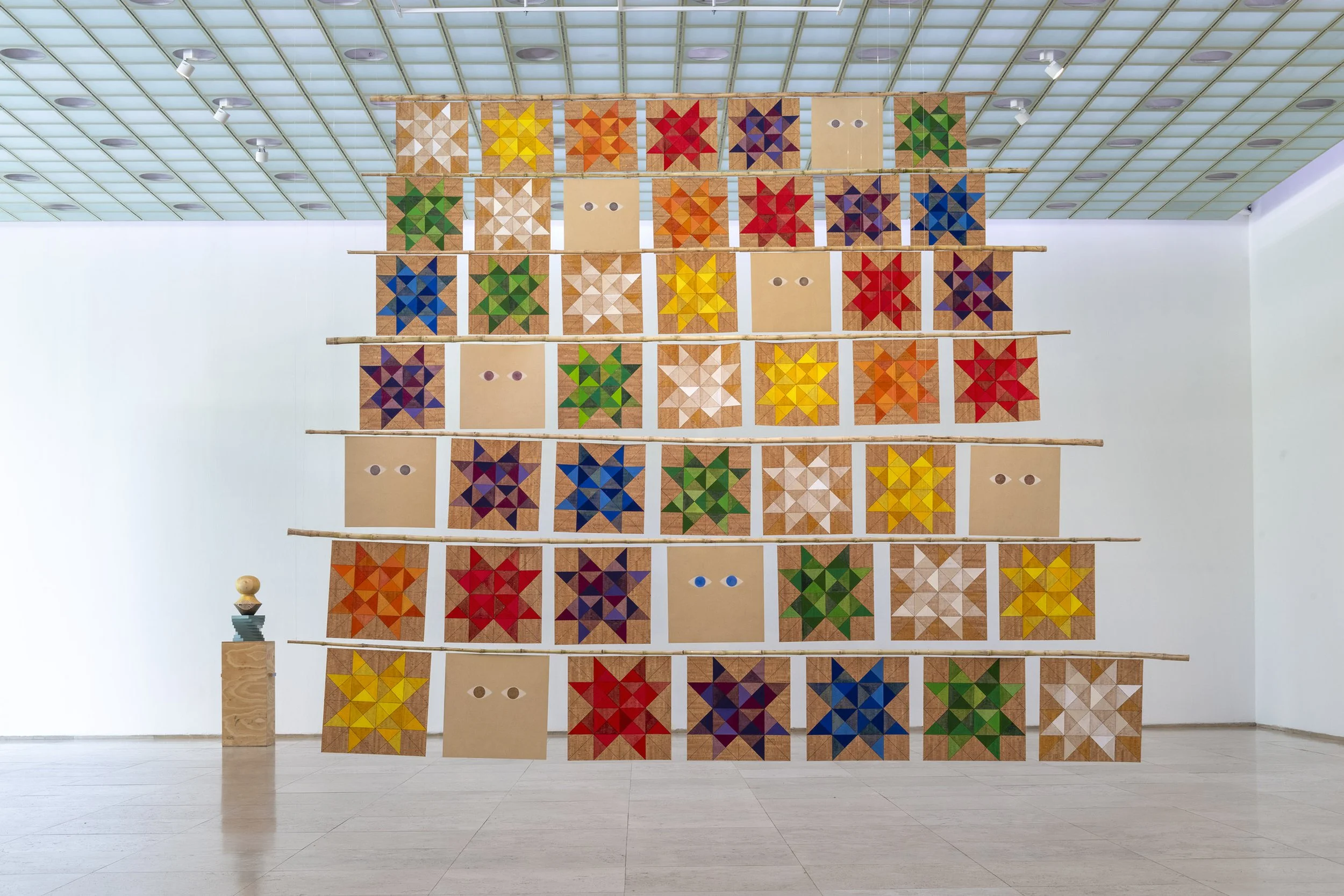
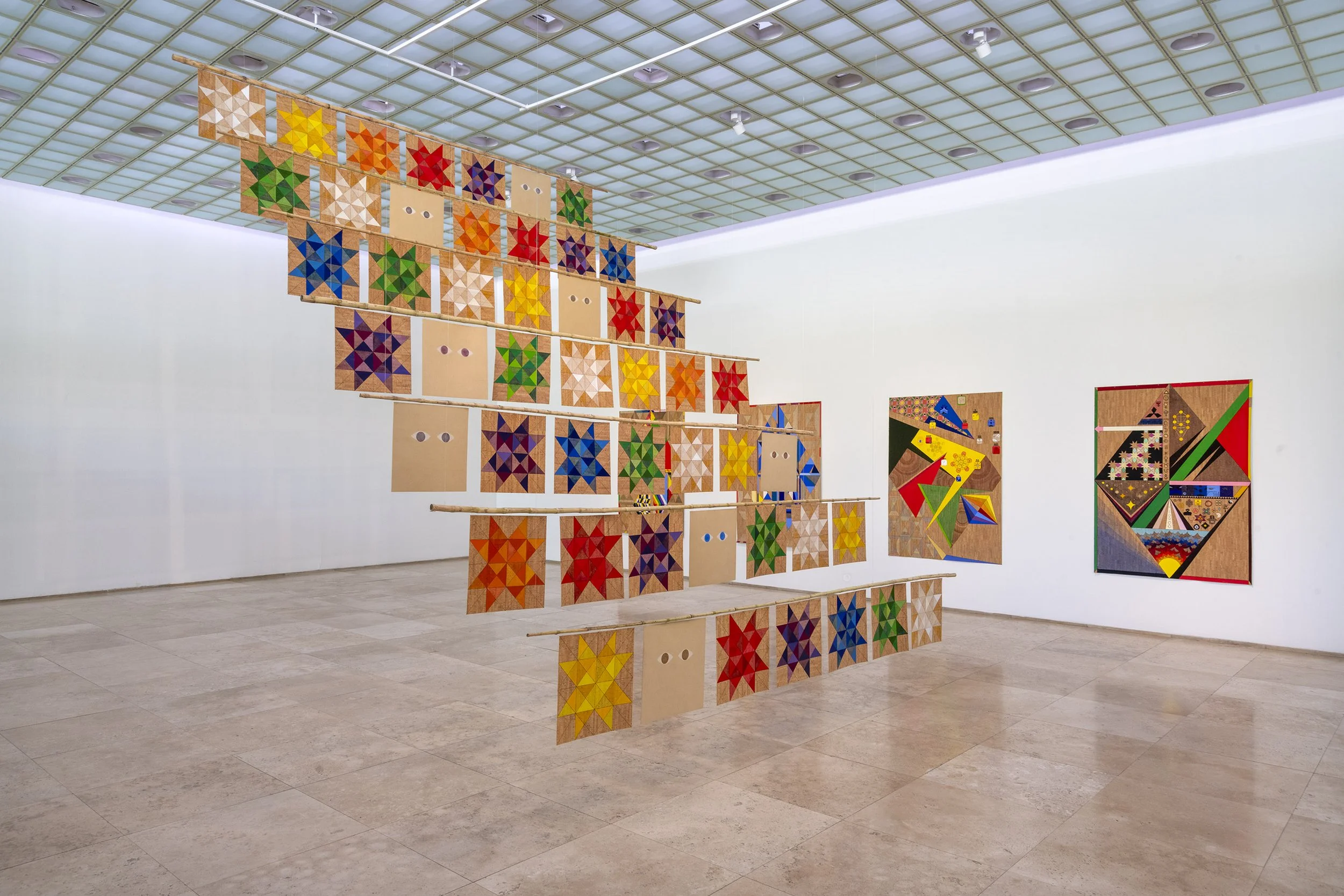
Further along, the work Todos Somos Uno (We Are All One, 2021) brings together forty-nine paintings on square cork panels, arranged in a suspended central configuration evoking the Wiphala, emblem of Andean peoples: a geometric composition of repeated square modules whose colors refer to the spectrum of the rainbow and whose interpretation, in different Andean contexts, links each tone to social, political, and cosmological dimensions. Each painting incorporates the figure of the Guñelve, an eight-pointed star belonging to the Mapuche visual tradition. On the reverse side of each piece appears the gaze of attentive eyes. If in previous installations all gazes were oriented in the same direction, here some diverge, suggesting both contemporary polarization and the possibility of sustaining difference without erasing it. The gaze of the chakaruna is necessarily multiple: capable of orienting itself toward several directions at once and of holding them without reducing them.
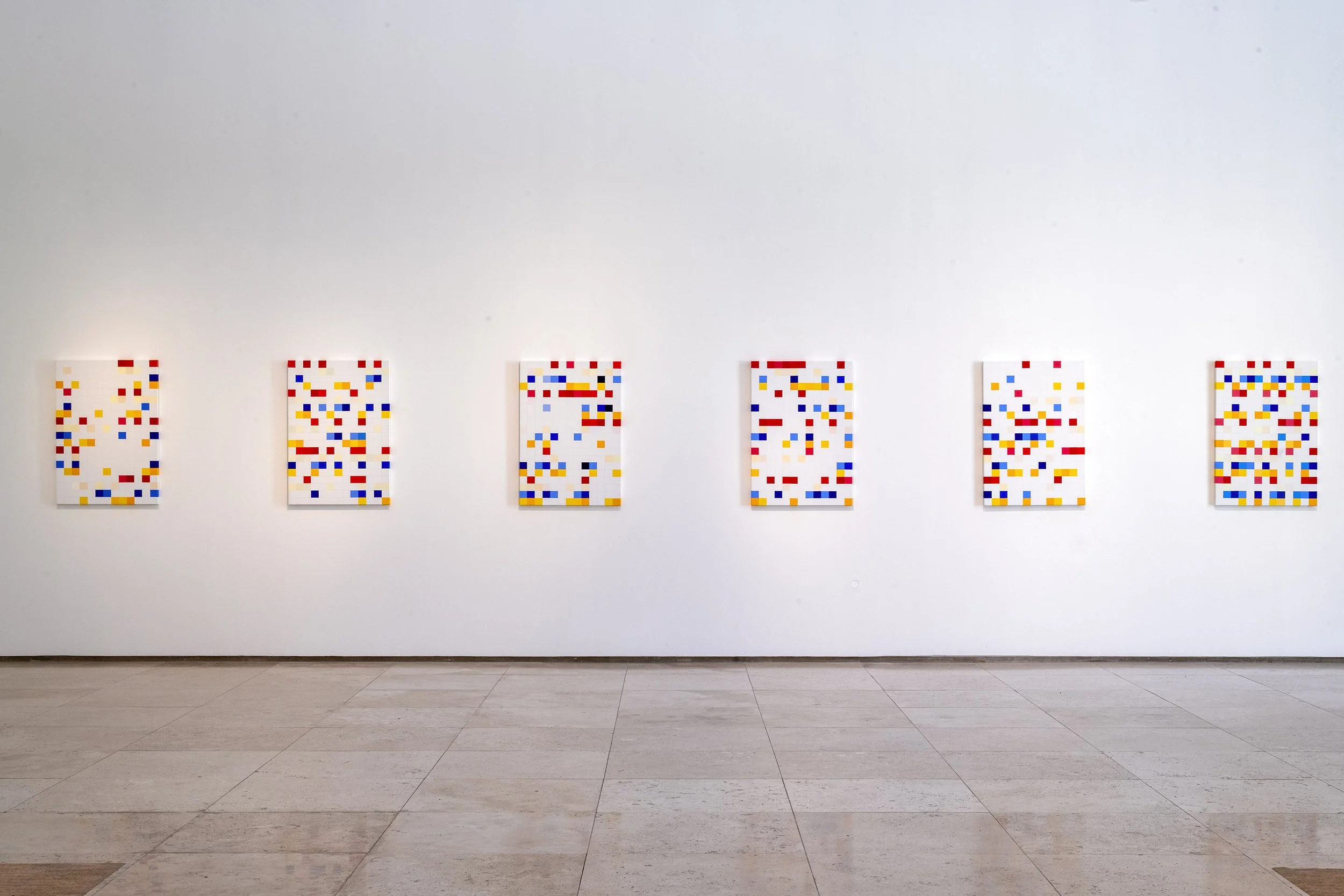
At a point in the exhibition that opens simultaneously as closure and as the beginning of a new cycle, Mi sincronario y sus constelaciones (My Synchronary and Its Constellations, 2026) gathers a series of abstract paintings reflecting the artist’s interest in Mayan calendrical systems, particularly the Tzolk’in. The work collects the birth dates of significant people in her life, inscribed within a central piece and abstractly unfolded across the surrounding paintings, configuring a network of relations that inscribes each birth within a chromatic constellation.
The underlying grid present in many of the works functions as a foundational structure: a framework that guides without determining, that supports without limiting. It may be understood as a form of gravity — a force organizing above and below, east and west, providing direction while simultaneously allowing freedom of movement. It is within this tension that the space of the in-between opens up: a space where it becomes possible to articulate what appears separate, sustain difference without annulling it, and rehearse new forms of relation.
Ultimately, Chakaruna: The Being In-Between does not seek to provide answers, but rather to create a space for reflection on how we act while traversing the liminal, while also proposing a practice: learning to inhabit the threshold, to recognize the interdependence that constitutes us and traverses everything, and to assume the responsibility of weaving bridges and threads of connection within an increasingly fragmented world.