
Decolonized History of Art: Global Narratives from 1900 to the Present.
A new ambitious online course by Institution School available to IKT members at a discounted rate.
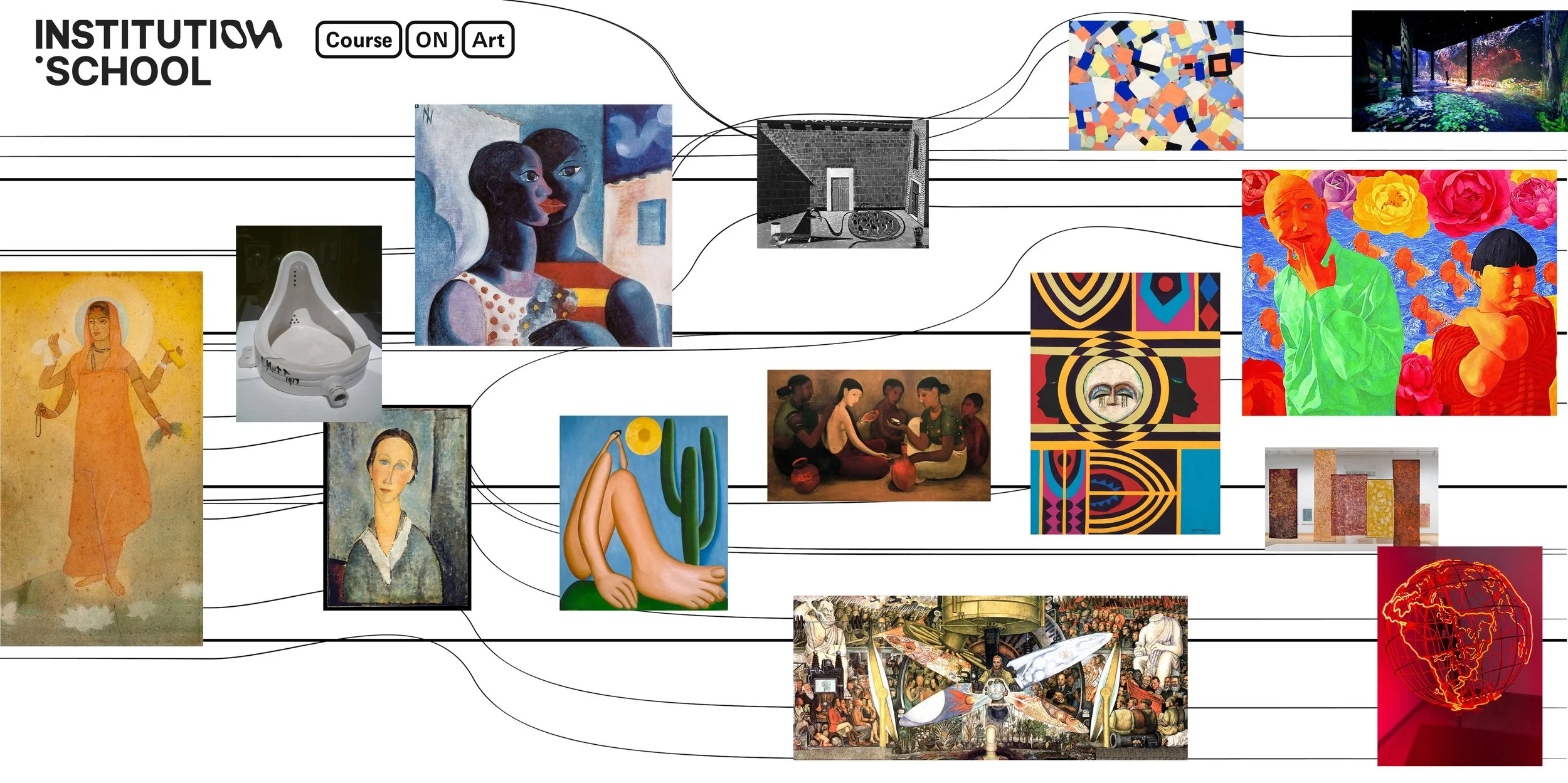
On January 17th, Institution School launches the online course in Decolonized History of Art: Global narratives from the 1900 to the present, a 12-week online course of 24 lessons designed for art professionals, curators, students and art enthusiasts interested in exploring art history from a broader, more inclusive perspective.
This represents one of the first sustained efforts to trace and articulate a truly global history of modern and contemporary art, offering an extensive and critically situated survey of 20th-century art histories through to an analysis of major contemporary trends and research trajectories, delivered through weekly live-streamed lessons on Zoom, every Wednesday (6 PM CET) and Saturday (3 PM CET), from January 17th to April 22nd.
The course will be held in English, and recordings will be available with subtitles in multiple languages.
Across 24 online lessons, the course follows how modern and contemporary art developed across the world, not as a single story, but through many parallel and intersecting histories and movements. It starts with the European avant-gardes and the construction of the modern canon, moving from Futurism to Dada and Surrealism, to then explore the artists and movements that expanded, questioned, or overturned its boundaries: from the Bengal School and Santiniketan modernism in South Asia, the Harlem Renaissance and the wider cultural renaissance of the Black diaspora, to the innovative art scenes of East Asia that blended local traditions with global influences. The course then dives into the postwar decades, a period of immense artistic tension and creativity. From Latin American muralismand Brazilian Concretism to the Khartoum School in Sudan and Eastern Europe’s neo-avant-gardes, you’ll see how artists responded to political upheaval, censorship, and social change with powerful new forms of expression.
Focus then shifts to the revolutionary ethos of the 1960s-80s, when art and activism became more deeply entwined, examining how Fluxus, Conceptual Art, and feminist art challenged institutions in the West, while Neoconcretism and Tucumán Arde in Latin America used participatory works to confront repression. It discusses the subversive performances within Eastern Europe's unofficial scenes, with artists like Tadeusz Kantor and Sanja Iveković, as well as how movements in Africa and Asia, such as the Sudanese Modernists or the Minjung collectives in Korea, engaged with postcolonial identity and social struggle.
Moving into the late 20th century, the focus shifts to art navigating a globalized world. It examines the rise of relational aesthetics and participatory practices in Europe and the United States, and the parallel focus on memory and the archive in post-socialist Eastern Europe. It discusses how democratic transitions in Latin America and post-independence contexts in Africa spurred work on history and identity, and how movements in East Asia, like Political Pop and Superflat, hybridized local forms with global culture. Finally, it turns to Indigenous artfrom the Pacific, which grounds itself in ancestral knowledge and cosmology.
The final module brings us to the art of the last decade, where creators operate at the cutting edge of technology, ecology, and material research. Here, digital and AI-driven experiments meet a profound reconsideration of history, materiality, and local knowledge, offering new ways to understand our place in the world.
Designed to move beyond familiar narratives, the program invites participants to rethink how art has been shaped by conflict, experimentation, and cross-cultural exchange. Rather than simplifying a complex century, it opens up a field of overlapping histories and artistic visions, offering tools to see how artists around the world have tried to make sense of their own time, and to remake it through their work.
About Institution and Institution School
Institution is a young, internationally oriented startup distinguished by its commitment to researching, developing, and promoting new cultural models. With an innovative and multidisciplinary approach, Institution School offers a wide range of courses and lectures spanning contemporary art, design, music, and more. The programs are designed to meet the needs of a broad audience as well as professionals and specialists such as artists, curators, and researchers. The primary goal is to provide participants with the essential tools to navigate the art world, enabling them to grow and deepen their interests in a focused and stimulating way.
Course Details
Decolonized History of Art - Global Narratives from 1900 to the Present.
Organized by: Institution School
When: from January 17th to April 22nd 2026, every Wednesday (6 PM CET) and Saturday (3 PM CET).
Where:
Live streaming on Zoom (24 sessions)
Duration of each lesson: 2 hours (6–8pm on Wednesday and 3–5pm on Saturday).
Approximately 1h 45m of lecture and 15m of Q&A between the instructor and participants.
Lessons held in English. Recordings available on demand via a dedicated link for three months after the end of the course.
Program and Faculty:
January 17th, 3 PM CET | Charles Esche - European Avant-gardes and the construction of the Modern
January 21st, 6 PM CET | R. Siva Kumar - Art, Anticolonial Activism and the Struggle for Independence in South Asia
January 24th, 3 PM CET | Samantha A. Noël - The New Negro Movement, Cultural Nationalism, and Modernism in the Black Diaspora
January 28th, 6 PM CET | Eileen Legaspi-Ramirez - Birth and Decay in Sites of Flux: Agentive Traces from Art of mid-20th Century in East and South-East Asia
January 31st, 3 PM CET | Christian Kravagna - The Making of post-War Modernism between Eurocentrism and Decolonization
February 4th, 6 PM CET | Shukla Sawant - Institutions, Associations and Disconnections: South Asian Artworlds after 1947
February 7th, 3 PM CET | Nada Shabout - Spirituality, Secularism, and Modernist Visions in West Asian Art in the Early Independence Period
February 11th, 6 PM CET | Natalia de la Rosa - Latin American Avant-Gardes: Interwar Hemispheric Networks and Transatlantic Dialogues
February 14th, 3 PM CET | Midori Yoshimoto - Post-1945 Transformations in East Asian Art
February 18th, 6 PM CET | Barbara London - Expanded Art Practices, Institutional Critique and the Postmodern Turn across Europe and the US
February 21st, 3 PM CET | Beáta Hock - Art Beyond Official Doctrines across Central and Eastern Europe
February 25st, 6 PM CET | Raphael Chikukwa - Decolonization and Artistic Renaissance across West and North-East Africa and the Black Diaspora (working title)
February 28th, 3 PM CET | Gaudêncio Fidelis - Repression, Resistance, and Spirituality in Latin American Art
March 7th, 3 PM CET | Morad Montazami - Modern Arab Art in a (Post)Colonial Context: Subjectivation, Independence, Emancipation
March 11th, 6 PM CET | Viktor Misiano - Artistic Practices Across the Soviet and Post-Soviet Space
March 14th, 3 PM CET | Nicolas Bourriaud - From Mass Culture to Social Practices at the Turn of the Century in Europe and the US
March 21st, 3 PM CET | Anda Rottenberg - Contested Memories and Contemporary Languages in Central and Eastern Europe in the Post-Socialist Transition (1989–2010)
March 25th, 6 PM CET | Tandazani Dhlakama - Art and Post- Independence Subjectivities from Africa
March 28th, 3 PM CET | Đỗ Tường Linh - Histories Without Footnotes: Contemporary Art in Southeast Asia
April 4th, 3 PM CET | Cecilia Fajardo-Hill - Post 1980s-intercultural, transhistorical, and politically situated art in Latinx America
April 8th, 6 PM CET | Pauline J. Yao - Artistic Transformations and Global Repositioning in East Asia
April 11th, 3 PM CET | Caroline Vercoe - Indigenous Art and Pacific Cosmologies
April 18th, 3 PM CET | Junghyun Kim - Digital Art, AI and New Ecologies
April 22nd, 6 PM CET | Ute Meta Bauer - Cultural Justice and the Return of the Material in Contemporary Art (working title)
Download detailed course syllabus (PDF)
Costs and Promotions
Single lesson: €25 / €18 for students under 26 and for residents of lower-middle and low-income countries
Full package (24 lessons): €350 (New year promotion of €300 available until 10 January)
Students under 26 and residents of lower-middle and low-income countries (see eligible countries): €180
Teachers: €220
IKT members: €50 discount valid across all full-package pricing categories. To request the discount code, please email ikt.curatorial@gmail.com (Discount available to active IKT members with 2026 membership fees paid.)
Register on Eventbrite
Contact Information:
Email: decolonizedart.subscriptions@institution.it
Registered office: Institution Srl — Piazza Garibaldi 12, 47018 Santa Sofia (FC)
Project funded by the European Union – Next Generation EU