
Myth and Kinship
KATES-FERRI PROJECTS & WILHELMINA GALLERY
561 Grand Street NY 10002
On view January 16 – February 21, 2026
Opening Reception: Friday, January 16th 6-8pm
Kates Ferri Projects & Wilhelmina Von Blumenthal’s Art Gallery, with curatorial advisor Micaela Giovannotti (IKT Member) , are pleased to present Myth and Kinship, a compelling dialogue between Greek artist Iasonas Kampanis and Mexican-American artist Salvador Jiménez-Flores, on view January 16 to February 21, 2026, with an artist’s reception on Friday, January 16, 6–8pm, at 561 Grand Street, NYC 10002.
This exhibition brings together two visionary practitioners whose work excavates the transformative power of ritual, mask, and the sacred within their respective Mediterranean and Mesoamerican cultural landscapes. Iasonas Kampanis’ work is accompanied by a text written for the exhibition by international curator Marina Fokidis, with Jiménez-Flores’ presentation featuring a text by Ulises Matamoros Ascensión.
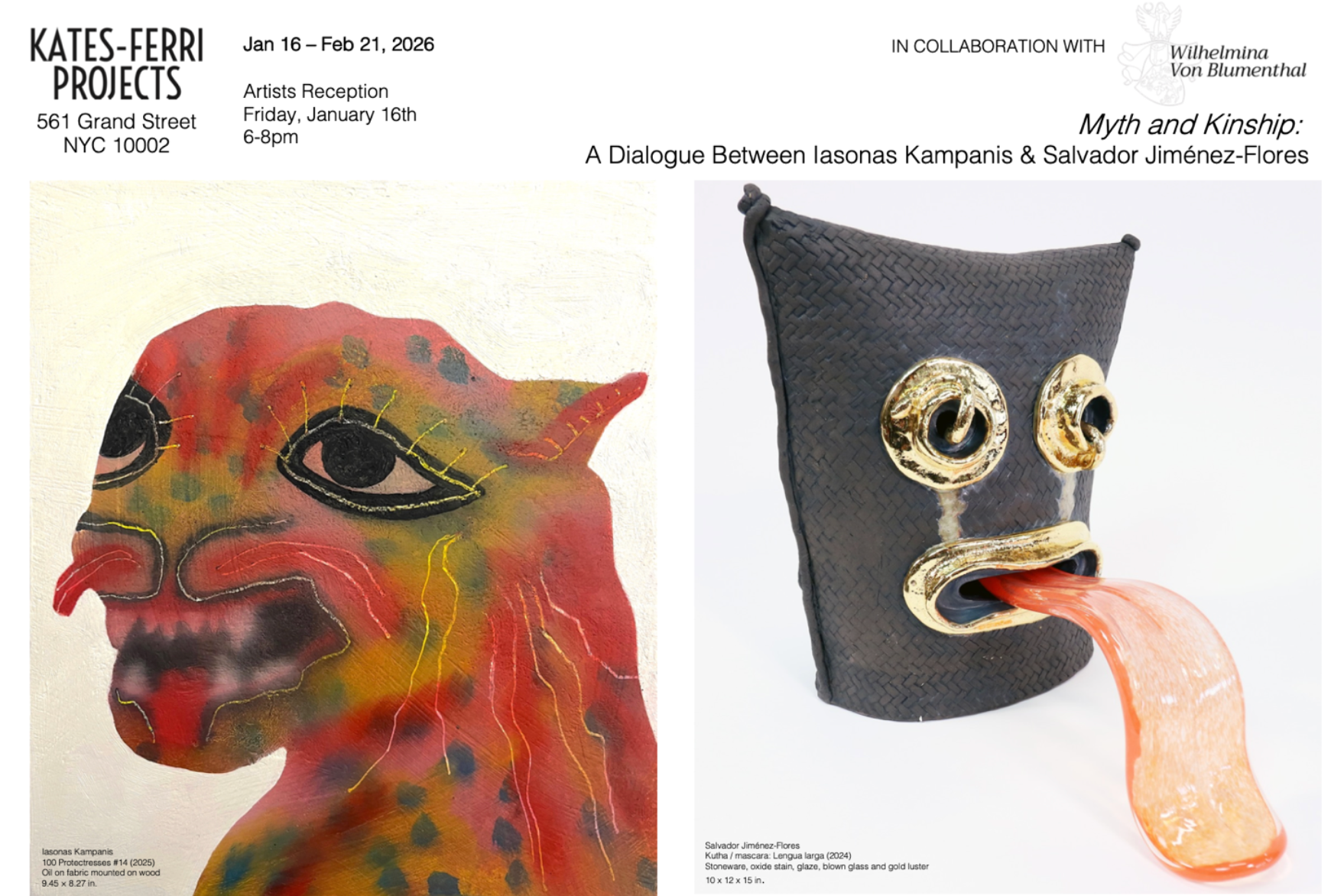
Iasonas Kampanis grounds his practice in Mediterranean animistic traditions, investigating humanity’s lost kinship with the natural world. His work channels the Dionysian essence within Greek spiritual tradition, predating the famous myths, where life and death exist not as opposites but as dual celebrations within the eternal circle. Through symbols drawn from ancient theatre, ritual dance, and ceremonial practice—eyes that witness, masks that transform—Kampanis creates portals to ekstasis, the Greek concept of standing outside oneself to merge with the collective. His chromatic vocabulary generates emotional states that acknowledge our place within, rather than above, the natural order. In an era of anthropocentric conquest, Kampanis reminds us that wearing the mask allows becoming, recognizing that humans are not superior to nature but integral threads in its transcendental fabric.
Salvador Jiménez-Flores inhabits a dual geography: born in Jalisco, Mexico, and raised from age fifteen in the United States. His practice emerged from the migrant experience of embodying multiple worlds. Through engagement with the Ngiba nation in Santa Inés Ahuatempan, Puebla, he discovered the tonal musicality of Indigenous language and transformative power of ancestral craft. His ceramic masks, evolved from his grandmother’s transgenerational woven techniques, function as containers for cultural hybridity, merging pre-Columbian iconography with futuristic imaginaries in what he calls “temporal futurism.” Glass eyes witness history while flame-like eyelashes reference wrestling masks; protruding tongues signal both thirst and defiance, doubled tongues speak to bilingual identity. Working between refined materials and “rascuache” aesthetics—a Mexican term for crafting from humble, second-rate materials—Jiménez-Flores transforms cultural contamination into creative resistance, producing exuberant forms that refuse binary logic.
Within these convergences and divergences, both artists recognize the mask as sacred technology—not mere representation but instrument of metamorphosis. For Kampanis, rooted in Greek theatrical and Orthodox traditions, the mask (or prosopon) enables ekstasis. For Jiménez-Flores, influenced by Ngiba ceremonial practice and Mexican folk traditions, the mask permits becoming other—a survival strategy and liberation tool for the diasporic subject. They converge in understanding that transformation, not preservation, constitutes the sacred act.
Yet their approaches to cultural memory diverge significantly. Kampanis seeks to restore humanity’s kinship with nature, positioning his work as recuperation of ancient spiritual interconnectedness severed by Western conquest and observation. Jiménez-Flores, conversely, embraces fragmentation as generative force. The migrant body exists in pieces across territories; hybridity and contamination become innate strengths rather than wounds. His circles spiral outward into speculative futures marked by irony and humor rather than nostalgia.
Color operates as emotional language for both artists, yet with distinct grammar. Kampanis employs chromatic intensity to generate transcendence, channeling Mediterranean light as communion with the sacred. Jiménez-Flores deploys color as festive rebellion—a vivid palette evoking both cartoon superheroes and ceremonial regalia, collapsing high and low culture into the “rascuache” aesthetic that transforms poverty of means into richness of invention.
Both recognize ritual dance as embodied knowledge. Kampanis sees dance as celebration of life and death unified, theatre as relational practice connecting human gesture to cosmic rhythm. Jiménez-Flores, influenced by Ngiba understanding that speaking, singing, and dancing form a continuum, creates sculptures that move and resonate, translating Indigenous tonal musicality into three-dimensional rhythm. Where one seeks to dissolve boundaries between artificial and natural worlds, the other negotiates borders between antagonistic cultural systems: Mediterranean unity meeting migrant multiplicity.
This exhibition stages not synthesis but dialogue: dia logos, the Greek term meaning “through meaning,” allowing difference to remain visible while revealing unexpected kinship.
The exhibition will feature new ceramic and mixed-media mask works from Salvador Jiménez-Flores, including Kutha/máscara: Lengua larga (2024), a dynamic stoneware sculpture incorporating oxide stain, glaze, blown glass, and gold luster. Combining petate-inspired (palm-woven) clay forms with the artist’s characteristic use of gold, the work transforms the extended tongue into both gesture and bridge between interior and exterior worlds. Kampanis will present his signature paintings, including 100 Protectresses #14 (2025), which continues his investigations into animal presence and absence, symbolic eyes as witnesses to place, and color-saturated environments that generate states of ekstasis and interconnection.
About the curatorial advisor
Micaela Giovannotti is a curator and writer based in New York, London, and Rome. She focuses on artist management and career mentorship, supporting creative artists’ practices through a holistic, vision-driven strategy.
Public Programme at the Metropolitan Museum of Art, NY 10028
Thursday, January 15th 2:00pm
Salvador Jiménez-Flores presents a Spanish-language talk on the ritual and symbolic significance of huésped figurines and the transformation of Mesoamerican ceramics from utilitarian objects into vehicles of identity and spirituality.
Thursday, January 15th 3:00pm
Athens-born artist Iasonas Kampanis leads an intimate walkthrough of The Metropolitan Museum of Art with select arts and cultural members in New York City. Kampanis will highlight works from the collection that inspire his artistic practice and share personal insights into his creative process.
Free with museum admission