
Who’s a good boy??
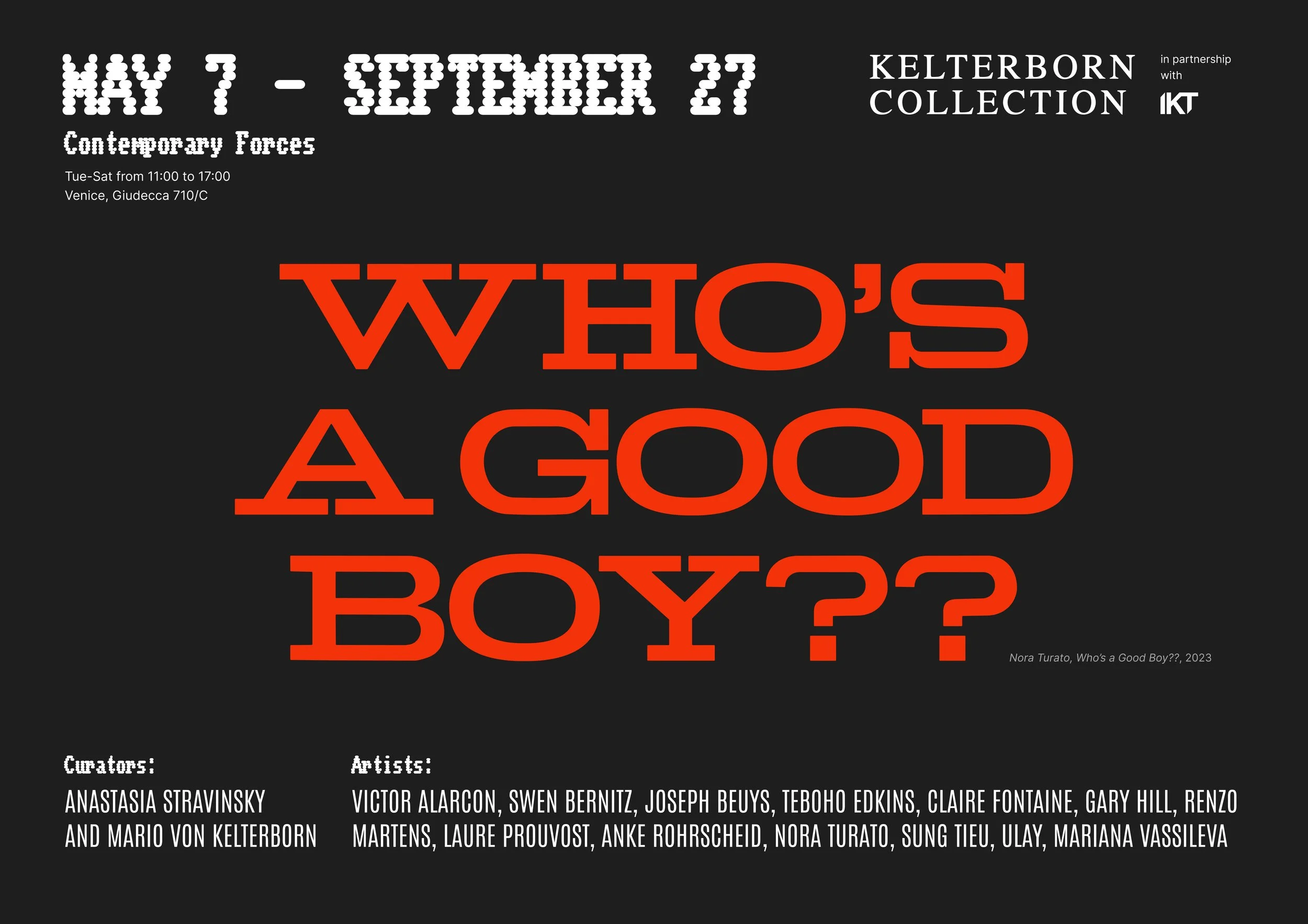
On view: 7 May–27 September
11:00–17:00, Tuesday–Saturday (During the Biennale opening week: 10:00–17:00)
Address: Contemporary Forces, Giudecca 710/C, CAP 30133, Venice, Italy (Google Maps)
https://www.instagram.com/contemporary_forces
The exhibition takes “the minor key” not as a metaphor, but as a method. In music, the minor does not negate the major; it alters its emotional register, introducing tension, vulnerability, and instability. Similarly, this exhibition approaches power through modulation rather than opposition. It unfolds as a score in which gestures of command and control resonate against quieter counterpoints.
In the climate of the 2020s — marked by war, militarization, propaganda, and invisible infrastructures of surveillance — minor tonalities become essential. These subdued registers, often overlooked, may be the ones capable of shifting perception. Named after Nora Turato’s Who’s a good boy??, the exhibition opens with a command — sharp, seductive, and destabilizing.
From this point, the exhibition unfolds across distinct yet interrelated registers. One group of artists examines the ethics of resistance and the perceptual conditions of power. Claire Fontaine establishes a philosophical ground in which nonviolence operates as an active structural stance. Anke Röhrscheid navigates the unstable threshold between abstraction and reality, fragility and threat, shifting perception away from literal representation toward affective experience. Ulay anchors this axis historically, while Swen Bernitz redirects attention to control as routine rather than spectacle, revealing authority as administrative normality rather than event.
Joseph Beuys condenses speech into a rhythmic oscillation between affirmation and refusal. Positioned outside the main exhibition space — almost hidden — the work operates in the minor register both conceptually and spatially. Language becomes repetition rather than declaration, a subtle destabilization of authority from the margins.
Another constellation interrogates language and transmission. Gary Hill exposes the instability of meaning, and Mariana Vassileva renders amplification uncertain, suspending voice between presence and muteness. Victor Alarcon operates at the level of atmosphere, composing space itself as a living score in which scent, breath, and movement activate a fragile shared ecology.
A further axis turns to invisible infrastructures of control and the calibration of perception. Sung Tieu and Renzo Martens examine how surveillance and image economies structure reality, while Teboho Edkins repositions listening as an ethical act. Across these works, authority appears not as spectacle, but as sedimented practice — learned, repeated, normalized.
Bringing together twelve artists from the Kelterborn Collection, the exhibition offers a focused articulation of its conceptual concerns. The selection reveals the collection’s underlying tonality, as reflected in the practices of Victor Alarcon, Swen Bernitz, Joseph Beuys, Teboho Edkins, Claire Fontaine, Gary Hill, Renzo Martens, Laure Prouvost, Anke Rohrscheid, Nora Turato, Sung Tieu, Ulay, and Mariana Vassileva. Presented in Venice during the 61st Biennale season, the exhibition does not compete with spectacle; it recalibrates it. Operating through tonal shifts — from command to hesitation, from dominance to resonance — it proposes the minor not as weakness, but as strategy.
Curated by Dr. Anastasia Stravinsky (IKT Member) and Mario von Kelterborn.
This exhibition is presented in partnership with IKT – the International Association of Curators of Contemporary Art. IKT is pleased to support this project and to contribute to the conversations it opens around power and language, and the subtle registers through which authority is felt, enacted, and resisted.