
Spotlight with Upendo Chitinka
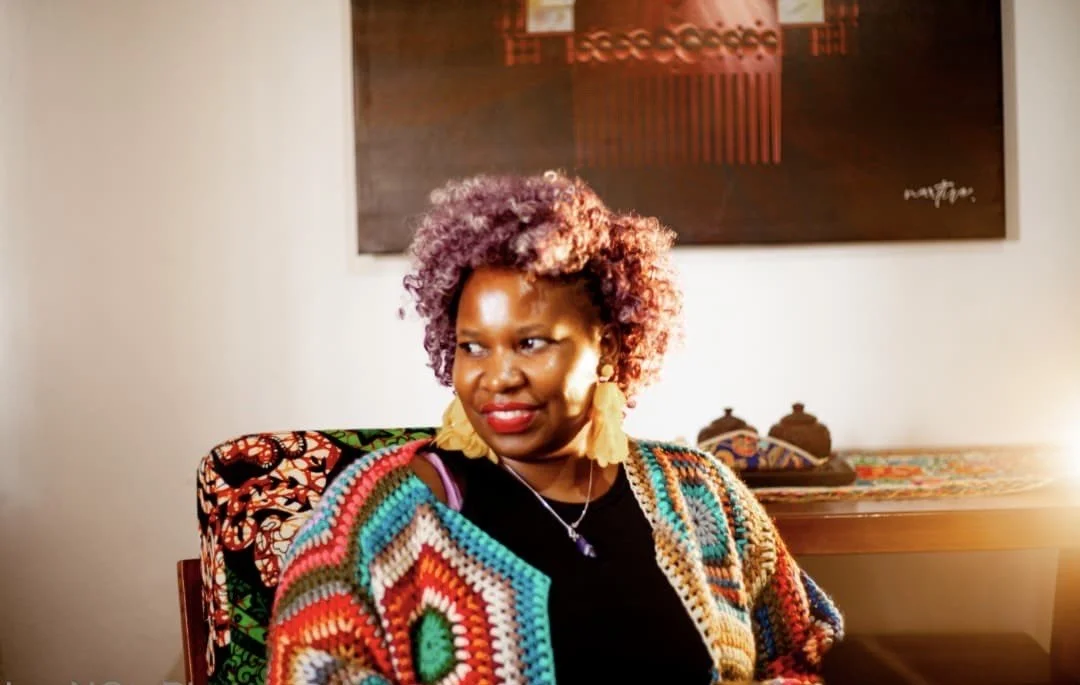
Upendo Chitinka, Independent curator, Dar es salaam, Tanzania
Could you tell us a little more about your background and how you got into curating?
I am a curator and aspiring researcher from Tanzania with a background in peace building, women empowerment and community development. I hold a Master’s degree in Research and Public Policy with a specialization in Peace Studies from the International Christian University (ICU) in Japan, and a Bachelor’s degree in Business Administration from India.
My journey into curating was not a conventional one. Growing up, I was always drawn to creativity.
After graduating, I worked for several years with peacebuilding organizations, focusing on gender equality and preventing violence against women. Working closely with communities exposed me to the realities of poverty and the incredible creativity that exists despite limited resources.
During the COVID-19 pandemic, at home alone, I started learning to write and reading a lot from poetry, essays, and short stories. A poem I submitted to a cultural programme organized by the Nordic embassies in Tanzania was selected, introducing me to a community of visual artists and creatives. That experience changed my perspective and introduced me to pursue curatorial studies.
While studying curating, as we designed our projects I was drawn towards the relationship between form and function, particularly through craft. Making objects by hand taught me to appreciate the labour, knowledge, and cultural history embedded in everyday materials. At the same time, my experience working with women artisans inspired me to create Contemporary Craft, a project that paired visual artists with women crafters to develop collaborative works towards creating economic opportunities.
Since then, I have curated my initiative projects including Bridging the Gap between Form and Function in Swahili Culture pairing visual artists and crafters into dialogue and creativity which we came with themes such DRESS, BODY and CULTURE
My master’s research, titled Visual Art and Peace Building: Exploring How Artists and Civil Society Organizations Can Incorporate Visual Art in Peace Building Initiatives, allowed me to investigate the role of visual art in social change through research conducted at Open Source Gallery in New York and interviews with artists across several continents.
Who/what has influenced your curatorial practice?
My curatorial practice has been shaped by a desire to find my place within the creative world and to explore the meaning of art. I have always seen art in everything and everywhere, but when I was introduced to curatorial practice, it felt like freedom. It gave me a way to connect my curiosity, creativity, and passion for working with people.
My work background has taught me to listen carefully, value different perspectives, and pay attention to whose stories are represented and whose stories are missing. This awareness continues to guide my work as a curator.
I am deeply inspired by culture and the ways people express themselves through art, craft, and everyday life. Whenever I enter a space, I naturally begin imagining how it could be transformed through artworks, artisans’ creativity, and storytelling. I enjoy imagining spaces that not only inspire people visually but also encourage learning, spark curiosity, and create meaningful experiences.
The role of the curator is continuously changing. Could you describe what it means to be a curator today?
For me, the word curator was unfamiliar at first. I remember telling people that I was studying curatorial practice, and they would often ask, “What is that?” Even today, as my practice continues to grow, I still find myself asking what it truly means to be a curator. It is a question I return to often, especially when people ask me, “What do you do?” or “What is your career?” Those conversations have led me to ask many more questions not only about curating, but also about art itself.
I see curating as an act of care. It has the power to either reproduce exclusion or actively work against it. For me, curating is about preserving cultural memory, encouraging dialogue, and creating space for multiple ways of seeing and understanding the world.
I am particularly interested in community-based curatorial practices rooted in local knowledge and lived experience. This means moving away from the idea of the curator as the sole authority and instead embracing a more collaborative and relational approach.
Today, I understand the curator as a storyteller, researcher, archivist, and bridge-builder, someone who connects people across disciplines, cultures, and generations while remaining aware of the responsibility that comes with shaping what is seen, valued, and remembered.
What’s next for you? What are your upcoming projects?
I am currently developing Nyumba ya Mikono, an emerging space dedicated to art, craft, cultural heritage, and community engagement.
Among my recent curatorial works included Echoes of Humanity, an exhibition about the power of wood, a living material that carries memory, spirit, and transformation.
As my practice continues to evolve, I find myself asking questions as much as seeking answers. One question that continues to stay with me is: Where does craft belong? I imagine an exhibition where a handwoven raffia basket sits alongside a contemporary installation not to compare them, but to invite a different question: What knowledge does each object carry? For me, that question is more meaningful than deciding what qualifies as “art.” I find myself reflecting. Who defines what art is? Where does craft belong within contemporary art? How can we preserve the knowledge and experiences of artists before they are lost?
These questions have inspired my next long-term project: a series of conversations with senior and pioneering artists from Tanzania. Through interviews, photography, writing, and archival research, I hope to document their artistic journeys, and reflections on creativity, tradition, and cultural value. More than recording biographies, I want to preserve how they understand art and their role in shaping visual culture. I hope their voices will become part of a larger conversation about the country’s artistic future.
My long-term vision is for Nyumba ya Mikono. I hope it will grow into a living archive and research platform that celebrates artists, preserves cultural memory, and creates resources for future artists, researchers, curators, students, and the public.
Looking ahead, I want to continue exploring how curatorial practice can connect contemporary art, traditional craft, and cultural heritage. I believe curating has the power not only to present art but also to ask important questions, preserve knowledge, and create spaces where communities can learn from one another.
What are you reading, watching, or listening to now, that is helping you to stay relaxed and positive?
Lately, I have been listening to music by Marya Mayan. One of my favorite songs is Art Finds You. Her work resonates deeply with me, and I find her creativity inspiring. Like how a mothers hand fixing a thread asking a question who define art, There is something about the way she poses questions about art in are lyrics how “art was there before Museum frames price tag art was first man looking fire not knowing what to call” combines art, storytelling, and music that gives me so much inspirations
I am also reading a book called Wake by Lisa McMann, a novel about a young girl who becomes trapped in other people’s dreams. I enjoy stories that explore imagination, emotions, and different realities.
When it comes to film and television, I am very visual and have always loved movies and series. While I watch many, only a few stay with me long after they end. Recently, Echos has been one of those stories that continues to live in my mind.
How long have you been part of IKT?
I recently became a member of IKT, and I see it as an important opportunity to connect with curators from different parts of the world. Coming from a background in community-based practice, and a space where curation is something foreign, I value learning from diverse curatorial perspectives while sharing experiences from Tanzania. I hope that through IKT I can continue expanding my research, building collaborations, and contributing to conversations about art, craft, and socially engaged curatorial practice.
Thank you Upendo!
Learn more about Upendo and her work: Instagram
Spotlight
The Spotlight series features short interviews with IKT members, offering insight into their work, ideas, and professional contexts. Through these conversations, we highlight the diverse practices, perspectives, and experiences that make up the IKT community, while creating opportunities for members to discover shared interests, find inspiration, and connect with potential collaborators.
Want to participate?
Send us a request to ikt.curatorial@gmail.com and we will send you interview questions.