
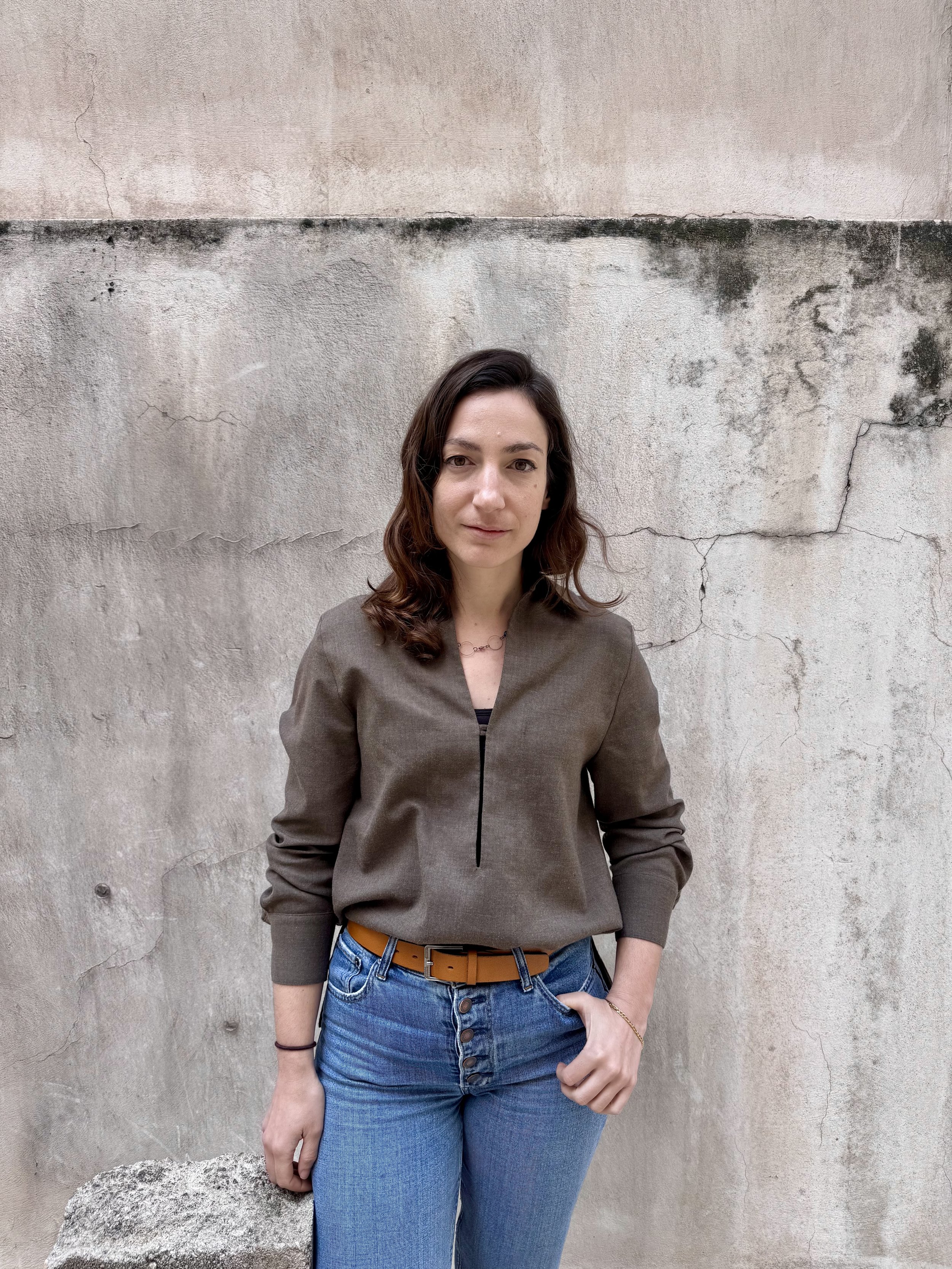
Àngels Miralda, Independent Curator, Amsterdam, Netherlands & Valencia, Spain
Could you tell us a little more about your background and how you got into curating?
I started curating without knowing that this was something people did professionally. I was always involved in writing and editing with student newspapers and I studied Art History in Rome. I have always been drawn towards artists and they have become my friends, mentors, and inspiration. While I was in university, I was very lucky to be in a class with Ilaria Gianni and that was the first time I understood that this was something you could build a career around.
The first exhibition that I list as my own was a group exhibition I organized at Podium (Oslo) that took place in 2016. That set the tone for the many exhibitions that have followed, which I have described as a “secret politics of materiality” that points towards silenced histories that can still be unearthed through geological archives and non-human script. For me, culture is always in relation to its environment and an integral part of the planetary and cosmic order.
Who/what has influenced your curatorial practice?
I would like to list both theoretical and practical influences. During my studies I gobbled up books and I read everything by Claire Bishop and Juliane Rebentisch, since I was interested in the parallel development of the contemporary role of the curator and installation art. I consider installation to be the paradigm shift from the modern to the contemporary because it brought art away from autonomy and into networks of relation with other art objects, but also with the viewer.
On a practical note, I worked for two artists, Lisa Oppenheim and Alexandre Singh, whose work I continue to admire and who allowed me to see artistic practice from within the everyday operations of the studio from very early on. I am also very influenced by my colleagues. Friendships are very important for me and are a sign of trust, respect, generosity and care towards others within working relationships. I have worked on many exhibition projects with Carola Uehlken and Sumesh Sharma, which have led to intense intellectual exchange and enriching connections. I have also been very influenced politically by Evrim and Jessica Oralkan and our time working on Collecteurs together, which was incredibly enriching and hopeful in terms of the connections and community we were able to build.
The role of the curator is continuously changing. Could you describe what it means to be a curator today?
This is an issue that I am currently working on and developing through my critical writing practice. Curating as we imagine it today is independent curating. If we consider Harald Szeemann as the father of curating, then curating comes from a conscious rupture with the institution. When Szeemann left his position as the director of the Kunsthalle Bern to open the Agency for Spiritual Guestwork, curating became an alternative to institutional narratives. Today, we see that the curatorial has returned to the institution and that it has gone backwards to the sort of curatorial position that already existed before Szeemann - that of the institutional curator whose mission is to care for a collection and to serve the needs of that institution rather than the artistic community. This last form has returned as the predominant curatorial role of today, which I profoundly lament.
I wrote about the current situation, in which positions and roles have become more important than the practice of exhibition-making, in my recent Frieze piece titled “Who Killed the Independent Curator?”, in which this pre-Szeemann positionality of the bureaucrat and the administrator subsumes the creative role of the independent curator. Of course, every institution is different and this tendency varies between institutions, but it exists on a consistent global scale.
Tell us about the latest exhibition that you curated.
Recently I curated the exhibition Wild Waters: Dams and Deltas After Modernity at Framer Framed in Amsterdam. This exhibition follows my interests in landscape and identity by grounding itself in the everyday experience of living on managed water in the Netherlands. This is the personal experience that every visitor to the exhibition brings with them and the string with which we build unexpected territorial alliances. The exhibition is organised as a compendium of short stories that each relates to a global context of hydrological infrastructures and the inheritance of the modern and colonial project. It starts rooted in the canal in front of the arts centre, with works by Suzette Bousema and a new film by Giovanni Giaretta, and then travels south and east with works by Abdo Zin Eldin, Ashfika Rahman, Adelita Husni Bey, Jumana Emil Abboud, Agniezsia Brzeżańska, Ewa Ciepelewska, Eunice Pais, Anna Moreno, Morteza Soorani, and Suat Ögüt. It is a constellation of contexts and historical realities, each contributing its own note and emphasis to a greater whole. I don’t give any closed reading of these stories other than emphasising the non-neutrality of hydrological infrastructure.
Next I will open a solo exhibition by Catalan artist Mireia Saladrigues organised by Mèdol at the Pretorium Tower in Tarragona. She has been working for a long time with dust as an artistic and narrative substance, which is a really interesting perspective that aligns with my interests. It will be an installation placed around the Sarcophagus of Hippolytus and points towards the millennia of layered history of this city.
What are you reading, watching, or listening to now, that is helping you to stay relaxed and positive?
I recently picked up a book I had been waiting to read for a long time. It is a series of interviews by Grace Ndiritu titled Dissent Without Modification: The 1990s. She interviews a series of radical women, and I am also currently interested in the decade of the 1990s. It was a decade of optimism, with a lot of flaws, but full of proposals for creating a better world on a scale unmatched since then. I have a feeling there is something to uncover there about where this all went wrong.
How long have you been part of IKT?
I am a new member of IKT. I joined because I believe it is important to hold serious discussions with other professionals about how curating is changing and challenges that we are currently facing. I look forward to staying connected with the group’s activities and members going forward.
Thank you Àngels!
Spotlight
The Spotlight series features short interviews with IKT members, offering insight into their work, ideas, and professional contexts. Through these conversations, we highlight the diverse practices, perspectives, and experiences that make up the IKT community, while creating opportunities for members to discover shared interests, find inspiration, and connect with potential collaborators.
Want to participate?
Send us a request to ikt.curatorial@gmail.com and we will send you interview questions.