
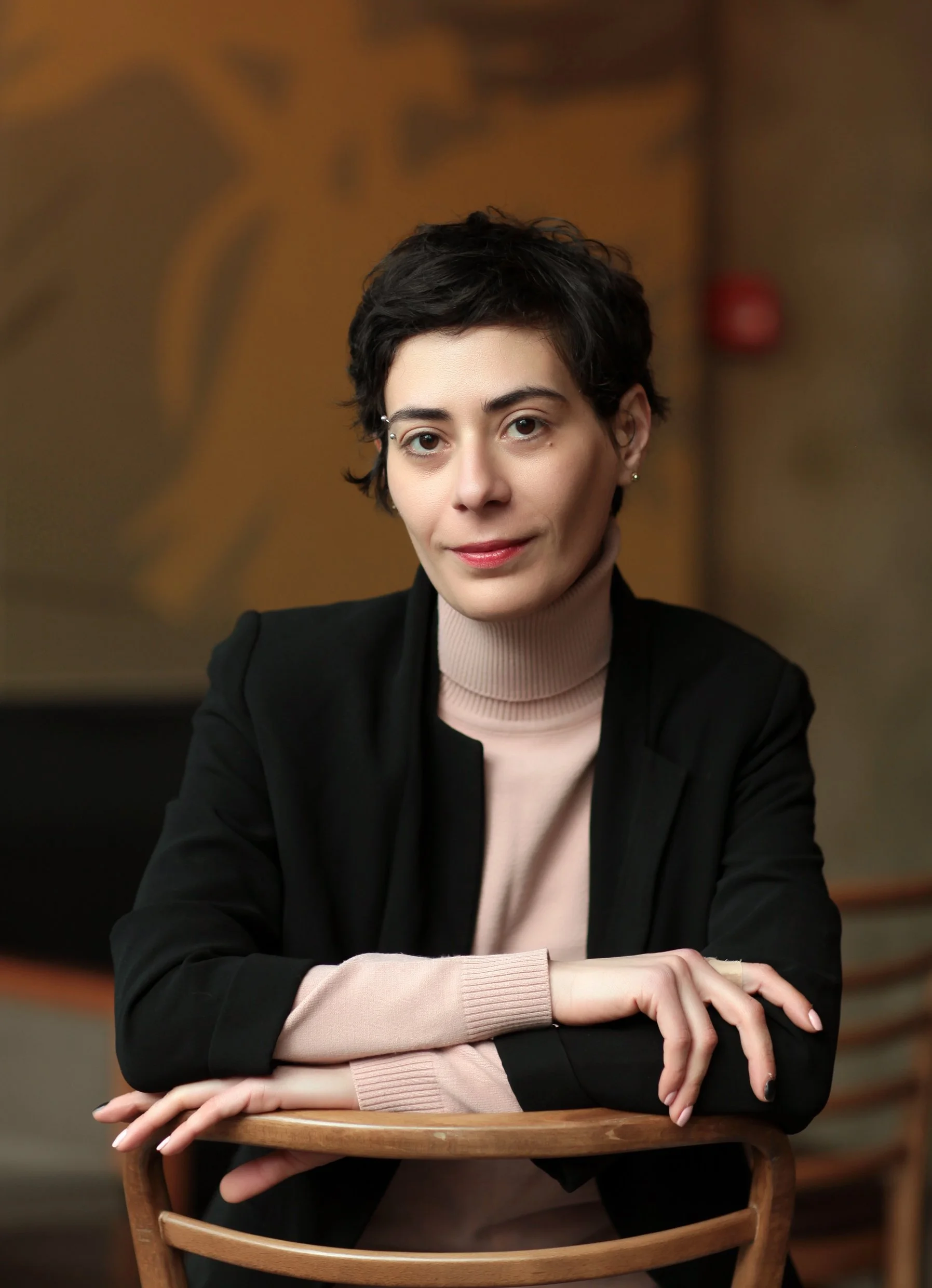
Sitara Ibrahimbayli, Curator & Artist / Co-founder and Creative Director of VarYox Art & Culture Platform / Founder of Otaq Gallery, Baku, Azerbaijan
Could you tell us a little more about your background and how you got into curating?
I came to curating through my practice as an artist. I studied photography at FAMU in Prague, and my work developed across photography, video, installation, and sound. Working with women’s narratives, identity, displacement, and care led me to think about how individual experiences connect to wider social structures.
Curating became a way to extend those conversations beyond my own work: to bring different voices together and create situations where artists and audiences could encounter one another. In 2018, I co-founded VarYox Art & Culture Platform in Azerbaijan. Through exhibitions, publications, workshops, and community projects, it has become a space where my artistic, curatorial, and social interests meet.
Who/what has influenced your curatorial practice?
My practice is strongly influenced by the women I work with: artists, artisans, and people whose knowledge is rarely represented within cultural institutions. Their experiences have shaped how I think about authorship, visibility, and the responsibility of a curator.
Working in Azerbaijan also means navigating the relationship between local histories and international contemporary art conversations. I am interested in how we can participate in those conversations while retaining the complexity of our own context.
Collaboration is another important influence. Working with curators such as Lesley Gray, and with artists and communities across different disciplines, continually challenges my assumptions. I learn as much from the process of making a project together as from its final presentation.
The role of the curator is continuously changing. Could you describe what it means to be a curator today?
For me, being a curator today means creating the conditions in which meaningful work can happen. This includes developing an exhibition’s ideas, but also building trust, finding resources, supporting artists, and considering who can access the resulting experience.
I belong to the first generation of artists who developed their practices in independent Azerbaijan after the collapse of the Soviet Union. Building a contemporary art practice in that period meant navigating limited infrastructure, resources, and opportunities. We often had to create our own platforms while finding our voices as artists. That experience of pioneering, with few established paths to follow, continues to shape my understanding of curatorial responsibility.
In an independent context, these responsibilities often overlap. You may be researching an exhibition while also negotiating a venue, raising funds, or working with a community over several months. I want this work to give the artists who come after my generation a stronger foundation: better access to resources, greater confidence, and more support to sustain their practices.
This is why I am particularly interested in what remains after an exhibition closes. Does a collaboration continue? Has someone gained an opportunity, a skill, or a new way to express themselves? The exhibition is an important moment, but I increasingly see curating as a sustained relationship, with a responsibility to build opportunities that outlast our own involvement.
Tell us about the latest exhibition that you curated.
My latest exhibition is YAŞA, XƏZƏR! / CASPIAN LIVE!, a solo exhibition by Farid Rasulov that opened on 30 October 2026. It is also the inaugural exhibition of Otaq Gallery, the space I founded in Baku’s Old City.
The exhibition considers the Caspian Sea as both a shared environment and a source of nostalgia for Azerbaijanis, closely connected to our personal memories and collective identity. Farid’s works draw on this emotional connection while bringing attention to the sea’s wildlife, ecological fragility, and the consequences of human activity. As a curator, I was interested in how these shared memories could open a conversation about loss and our responsibility for the sea’s future.
Opening Otaq is also an important step in my wider practice: creating an ongoing space for Azerbaijani contemporary artists, where exhibitions can develop into conversations, collaborations, and relationships with audiences and collectors.
What’s next for you? What are your upcoming projects?
I am developing the next edition of Her Art in Action, our festival centred on women’s artistic practices. The 2027 theme, The Third Space, opens questions about how we create spaces for encounter, dialogue, and coexistence through everyday relationships, education, care, and creative work.
Another ongoing focus is Rooted Hands, a project with women reed weavers in Masally. What began as an effort to preserve a traditional craft has grown into an international platform for women artisans, connecting their knowledge and practice with new audiences, collaborations, and economic opportunities. Its next stage is a hub for making and selling, alongside research, archiving, and residencies.
Across these projects, I want to build structures that allow relationships and ideas to continue developing over time.
What are you reading, watching, or listening to now, that is helping you to stay relaxed and positive?
I am currently reading Egana Djabbarly’s My Dreadful Body. Musically, I always return to Radiohead. I have also been listening on repeat to A Trace of Grace, featuring Alim Qasımov, Hüsnü Şenlendirici, Rauf İslamov, and Michel Godard. The film that most recently left a strong impression on me was It Was Just an Accident.
How long have you been part of IKT?
I joined IKT in May 2026, so I am still relatively new to the association. For me, its value lies in the opportunity to build an ongoing exchange with colleagues working in different cultural and institutional contexts.
Working independently in Azerbaijan, I appreciate opportunities to discuss the practical and ethical questions of curating with a wider community. I am interested in sharing perspectives from our region while learning how others approach similar challenges.
I see IKT as a space where these relationships can grow over time, and I look forward to contributing through future exchanges and collaborations.
Thank you Sitara!
Learn more about Sitara and her work: Website / Instagram
Learn more about VarYox: Website / Instagram
Spotlight
The Spotlight series features short interviews with IKT members, offering insight into their work, ideas, and professional contexts. Through these conversations, we highlight the diverse practices, perspectives, and experiences that make up the IKT community, while creating opportunities for members to discover shared interests, find inspiration, and connect with potential collaborators.
Want to participate?
Send us a request to ikt.curatorial@gmail.com and we will send you interview questions.