
Spotlight with Vsevolod Seva Kovalevskij
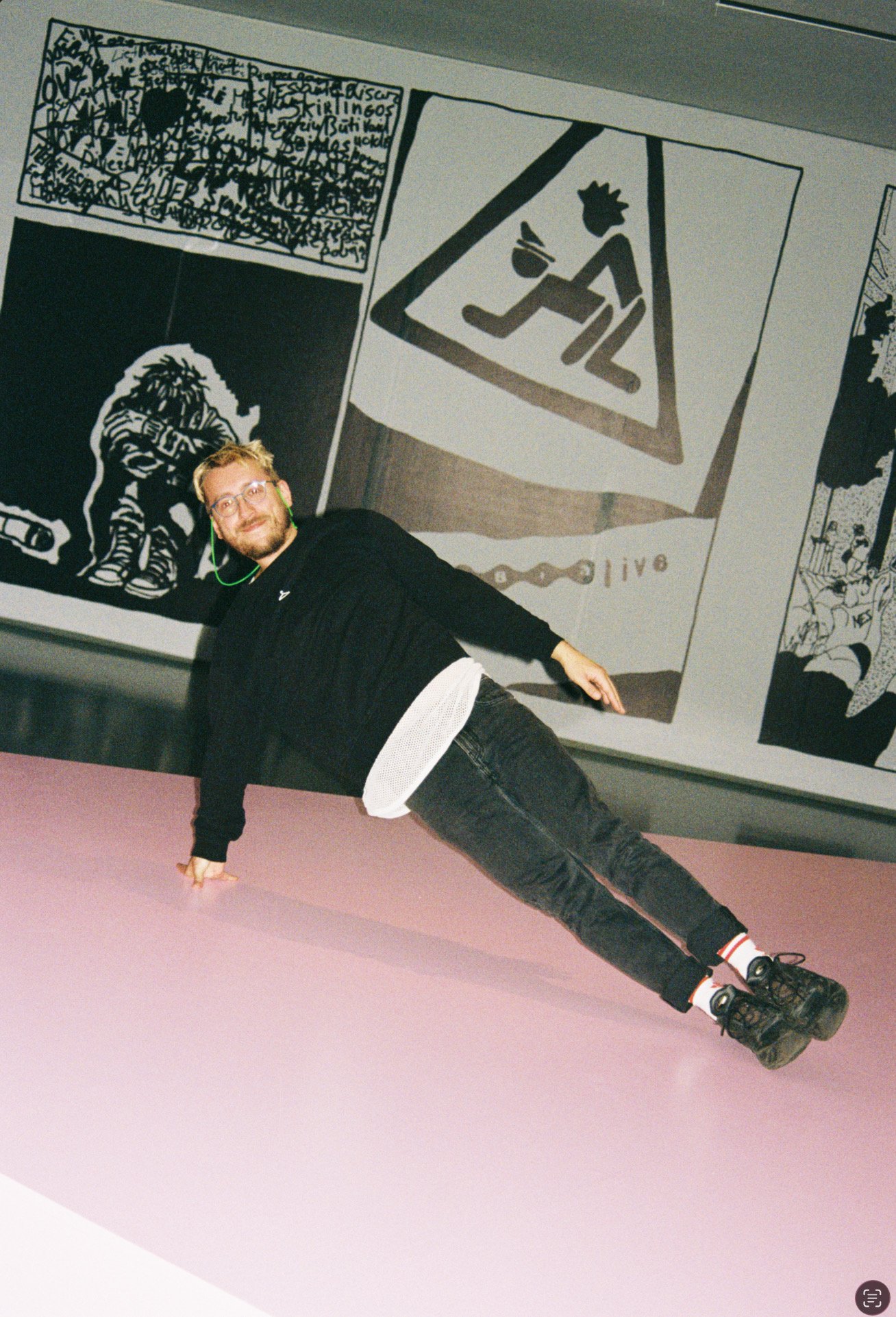
Vsevolod Seva Kovalevskij, Independent Curator & Activator, Vilnius, Lithuania & Oslo, Norway. Photo by Agota Lukytė
Could you tell us a little more about your background and how you got into curating?
My background is in visual arts, curating, and exhibition-making. I studied at the Vilnius Academy of Arts, the Tromsø Academy of Contemporary Art, and Goldsmiths, University of London. I came to curating through my artistic practice and a desire to create opportunities for artists beyond established institutional structures.
I started by initiating independent projects, including Young Poor Artists, and later ran artist-led spaces such as Malonioji 6 and Sodų 4 in Vilnius. These experiences eventually led me to establish InTheCloset, a mobile artistic and curatorial platform exploring queer identities, visibility, and cultural memory.
My work has since moved between independent spaces and institutions, including the Contemporary Art Centre in Vilnius and Tromsø Kunstforening. At the Contemporary Art Centre, I led the technical department and coordinated exhibition production while also developing curatorial projects. Working across these roles taught me to approach exhibitions as conceptual, spatial, and collaborative processes, shaped as much by people and practical decisions as by ideas.
For me, curating remains inseparable from artistic practice. It means bringing different voices and histories into dialogue, supporting experimentation, and making room for narratives that might otherwise go unseen. I continue to work between the roles of artist, curator, and exhibition architect.
Who/what has influenced your curatorial practice?
Perhaps somewhat paradoxically, one of the strongest influences on my curatorial practice has been the lack of opportunities to experience truly inspiring curatorial approaches firsthand. Rather than being shaped by a particular curator or school of thought, I was often motivated by what I felt was missing in my encounters with curatorial practice.
I have experienced situations where curating seemed more concerned with establishing the curator's own narrative than engaging with the artists and their work. This made me question the power dynamics between artists, curators, and institutions, and think about how these relationships could function differently.
My own experience as an artist has probably been equally influential. It has taught me how important trust, dialogue, generosity, and genuine curiosity are in developing exhibitions.
I don't believe a curator needs to have all the answers or impose a predetermined interpretation. I am much more interested in creating conditions where unexpected things can happen, where artists have room to experiment, and where different perspectives can coexist.
In that sense, my curatorial practice has developed as much through questioning existing approaches as through learning from them.
The role of the curator is continuously changing. Could you describe what it means to be a curator today?
I think being a curator today means being comfortable with contradictions. Institutions want experimentation, but also predictability. They speak about openness, yet often decide who belongs long before an exhibition even begins. I find curating most interesting precisely within these tensions.
Coming from artistic practice and exhibition production, I have little patience for the idea of a curator as someone who simply selects artworks and writes an intelligent text about them. Sometimes curating means fighting for an artist's fee, finding a space where none exists, questioning institutional decisions, or convincing someone to take a risk.
I am also increasingly suspicious of exhibitions where the curator's concept is so tightly constructed that the artists have little room to breathe. I prefer projects that can surprise me, change direction, or even contradict my original intentions.
Through InTheCloset and my independent projects, I have become interested in curating as something that doesn't necessarily require an institution, a permanent space, or even an exhibition.
For me, curating is not about controlling meaning or demonstrating authority. It is about making things possible that otherwise might never happen.
Tell us about the latest exhibition that you curated.
My most recent project was Margins & Miracles at the National Gallery of Art in Vilnius, where my roles as artist and curator came together. The exhibition explored queer visibility, cultural memory, and the uncomfortable relationship between marginalised identities and the institutions that claim to represent them.
For me, one of the most interesting aspects was bringing InTheCloset, originally conceived as a mobile, independent artistic platform, into one of Lithuania's most prominent national art institutions. There is something fascinating, and perhaps slightly absurd, about bringing the margins into the centre and seeing what happens.
Alongside my own new works, I developed a programme of moving images, performances, educational activities, and encounters with artists. I wanted the exhibition to function as something alive rather than a finished statement on the walls.
What comes next is still taking shape. I am currently exploring possibilities for presenting the project internationally, particularly in Norway and Belgium, while continuing to develop InTheCloset as an artistic and curatorial platform.
I am interested in what happens when a project moves between different political, cultural, and institutional contexts. Can the same exhibition still ask the same questions, or does everything change when it crosses a border?
What are you reading, watching, or listening to now, that is helping you to stay relaxed and positive?
At the moment, I am reading project proposals for the Lithuanian Council for Culture, which is not exactly relaxing, but certainly keeps me curious about what artists are thinking and working on.
Alongside that, I am researching the concept of the closet and reading Jack Halberstam's In a Queer Time and Place: Transgender Bodies, Subcultural Lives. So, even my leisure reading tends to turn into research.
To disconnect a little, I am rewatching Foundation on Apple TV+. I enjoy getting lost in its complex worlds and imagining alternative futures. And perhaps most importantly, I am trying to make it to the gym four times a week. So far, maintaining that routine might be my most ambitious ongoing project.
How long have you been part of IKT?
I only recently joined the IKT community, so I am still discovering its people, conversations, and possibilities. What attracted me was the opportunity to connect with curators working in different cultural and institutional contexts, exchange experiences, and perhaps question some of our established ways of working.
It is still too early to speak about its direct impact on my practice, but I am looking forward to building new relationships, discovering different perspectives, and hopefully developing collaborations that go beyond simply exchanging business cards at exhibition openings.
Thank you Vsevolod!
Spotlight
The Spotlight series features short interviews with IKT members, offering insight into their work, ideas, and professional contexts. Through these conversations, we highlight the diverse practices, perspectives, and experiences that make up the IKT community, while creating opportunities for members to discover shared interests, find inspiration, and connect with potential collaborators.
Want to participate?
Send us a request to ikt.curatorial@gmail.com and we will send you interview questions.