
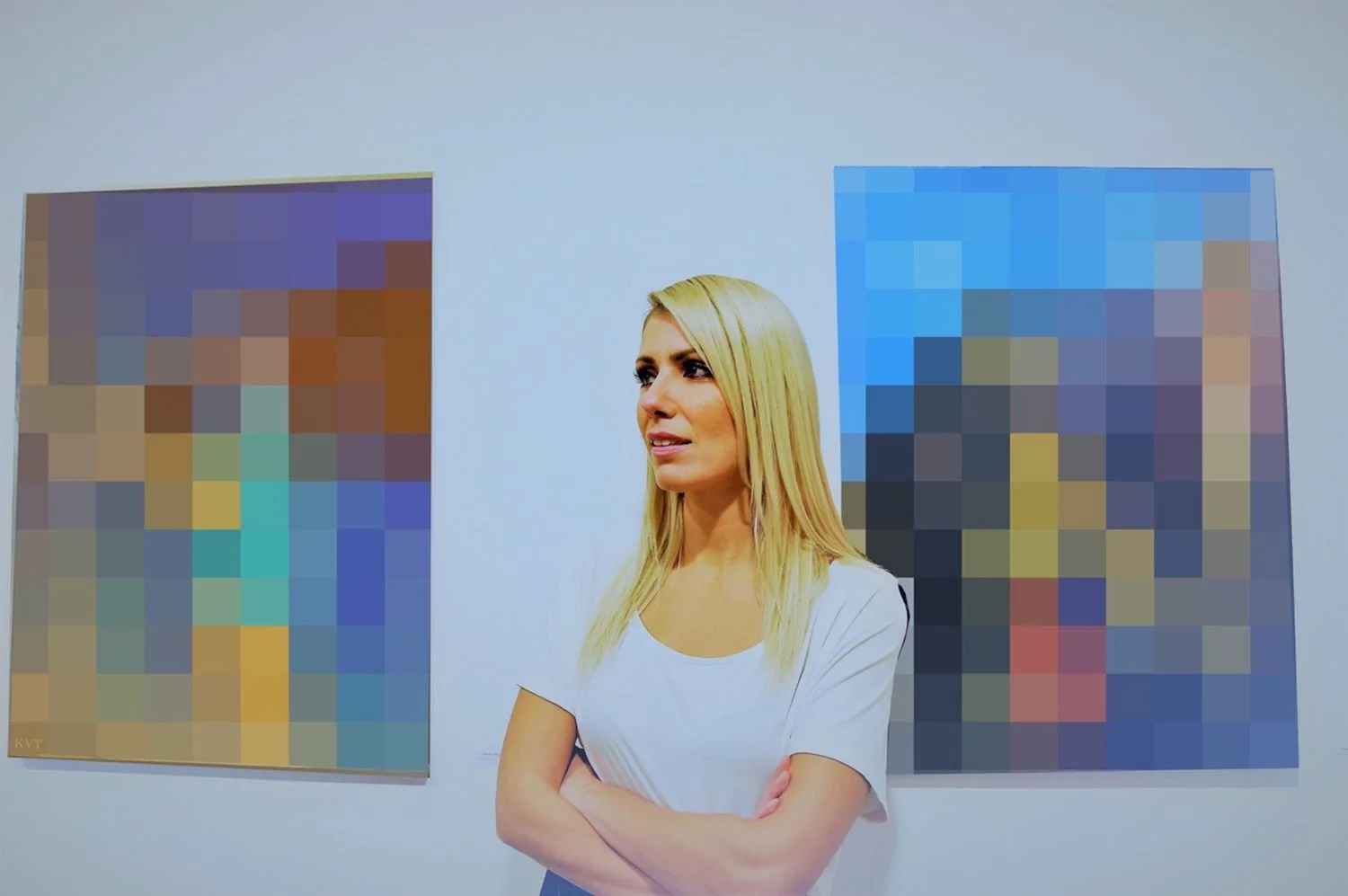
Valentini Margaritopoulou, Independent Curator & Museologist, Larissa, Greece
Could you tell us a little more about your background and how you got into curating?
My background combines art history, museum studies, and hands-on experience within museums, galleries, and independent cultural initiatives. I studied History at the Ionian University, specializing in Art History, attending also summer BA courses in Courtauld Institute of Art in London and later completed an MA in Cultural Heritage and Museum Studies at University College London (UCL). During my studies and early professional years, I had the opportunity to work closely with institutions such as the National Portrait Gallery in London, the Benaki Museum in Athens, Zoumboulakis Galleries in Athens, and the Municipal Gallery of Larissa City – G.I. Katsigras Museum among other. I gradually moved toward curating because I became increasingly interested not only in artworks themselves, but in the relationships that emerge between artworks, artists, audiences, and public space. Curating felt like a natural extension of my academic background and my need to create meaningful dialogues through art. Over the years, my practice expanded from institutional exhibitions to interdisciplinary projects, performances, public interventions, murals, and collaborations with contemporary artists across Greece. What continues to inspire me is the possibility of creating spaces where art can generate reflection, participation, and emotional connection.
Who/what has influenced your curatorial practice?
My curatorial practice has been shaped by both institutional experience and independent artistic collaborations. Working within museums and archives taught me the importance of research, historical continuity, and the responsibility of cultural preservation. At the same time, collaborating with contemporary artists, performers, musicians, and public art initiatives introduced me to more experimental and interdisciplinary approaches. I am particularly influenced by the relationship between art and public space, as well as by curatorial practices that emphasize participation, dialogue, and social engagement. Literature, cinema, philosophy, and everyday urban experience also play an important role in the way I think about exhibitions and storytelling. Above all, I am influenced by artists themselves, by the conversations, processes, and forms of vulnerability that emerge during collaboration. Curating, for me, is never simply about presenting works; it is about creating conditions for encounters and shared experiences.
The role of the curator is continuously changing. Could you describe what it means to be a curator today?
Curating today means inhabiting a state of constant movement. It is no longer a fixed discipline but an evolving ecology of relations, narratives, encounters, and forms of care. A curator moves between artists, artworks, spaces, audiences, and ideas, building temporary constellations that allow new meanings and conversations to emerge. I often think of the curator as a kind of seismograph, an idea that Nicolas Bourriaud has described beautifully and with which I strongly identify. The curator listens closely to the subtle vibrations of the present, to social shifts, cultural tensions, emotional undercurrents, trying to understand how these movements shape the world around us. Curating, for me, begins with attention and listening. An exhibition is never simply a display of objects. The moment two works are placed in dialogue, a new field of meaning is produced. Every curatorial gesture carries a position, consciously or unconsciously, and therefore every exhibition also becomes a way of reflecting on the political, social, and emotional conditions of its time. Art belongs to the polis; it creates a shared space where we negotiate memory, identity, truth, fiction, intimacy, and collective experience. What interests me most today is the possibility of curating as a living conversation rather than as a fixed statement. I see exhibitions as open structures that invite participation, vulnerability, and unexpected encounters. Curating is not only about interpretation; it is also about creating conditions where something can happen between people, artworks, and space. Ultimately, curating is an act of care, but also an act of responsibility toward the present and the future. It requires remaining alert, receptive, and emotionally available to the complexity of the world we inhabit.
Tell us about the latest exhibition / project that you curated.
One of my latest projects was the curation of the embodied performance THALLO, performed by Maria Kyrma, with video and soundscape by Kostis Tsiachas, presented at the 12th MpArt Festival Exodus in Larissa (Greece) in 2025. The project explored the relationship between the human body, memory, landscape, and ecological transformation through an immersive performative experience. The video version of the performance was later presented at the conference Anthropocenic Performativity & Performance: Poetry, Environment, New Technologies and AI in February 2026 at the Archaeological Museum of Patras. I am particularly interested in projects that move across disciplines and challenge the traditional boundaries between visual art, performance, sound, and public engagement. My upcoming projects include the curation of a solo photography exhibition focused on cyanotype techniques at Alma Gallery in Athens (Greece) this June, as well as the curation of a new public mural in the region of Thessaly (Greece) this summer.
What are you reading, watching, or listening to now, that is helping you to stay relaxed and positive?
Lately I have been reading novels by Sally Rooney, whose subtle emotional intensity and observational writing I deeply appreciate. At the same time, I always return to Greek poetry, especially the works of Odysseas Elytis, George Seferis, Kostis Palamas, and Yannis Ritsos. Poetry helps me reconnect with language, memory, and silence in a very essential way. Cinema is also an important part of my daily life, I am trying to watch one film every day, while music, especially jazz, remains a constant source of balance, improvisation, and inspiration. At the same time, a completely different but equally meaningful world has opened again in my life through my second two-year-old son: I read many children’s books with him and, inevitably, watch Bluey as well, which, surprisingly, often feels like a small lesson in tenderness, imagination, and everyday joy. And with my twelve-year-old son, we also share a love for cinema and spend a lot of time watching films together, something I deeply treasure.
How long have you been part of IKT?
I have only recently become a member of IKT, but I already see it as an important opportunity to connect with an international network of curators and contemporary art professionals. I value spaces that encourage dialogue, exchange of ideas, and collaboration across different cultural contexts, and I believe that being part of IKT will further enrich and expand my curatorial perspective and practice.
Thank you Valentini!
Spotlight
The Spotlight series features short interviews with IKT members, offering insight into their work, ideas, and professional contexts. Through these conversations, we highlight the diverse practices, perspectives, and experiences that make up the IKT community, while creating opportunities for members to discover shared interests, find inspiration, and connect with potential collaborators.
Want to participate?
Send us a request to ikt.curatorial@gmail.com and we will send you interview questions.