
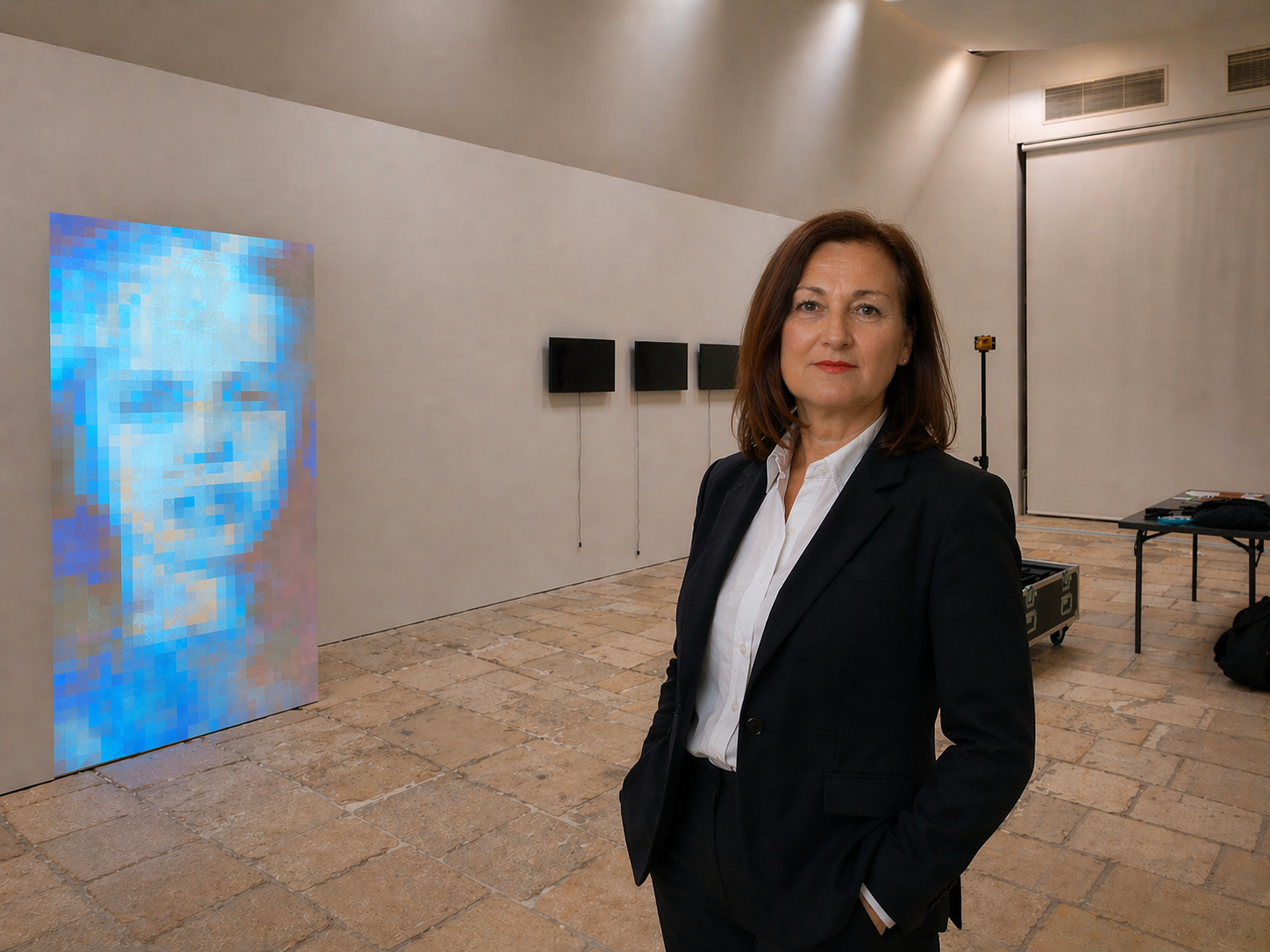
Verena Voigt M.A., Gesellschaft für zeitgenössische Konzepte e.V., Potsdam, Germany
Could you tell us a little more about your background and how you got into curating?
I worked for many years with international curators and within art institutions—as a writer, a journalist, and as someone accompanying, contextualizing, and critically reflecting on exhibitions. This close engagement with exhibition-making shaped my thinking early on. It made clear to me that visibility is never neutral, but always the result of structural decisions—within institutions, discourses, and political frameworks.
Today, I would say these structures have not disappeared but expanded. Alongside institutional contexts, we now see technical infrastructures increasingly organizing, filtering, and hierarchizing visibility. Since 2011, I have been curating and publishing within the Potsdam based art association Gesellschaft für zeitgenössische Gesellschaft e.V., where I have developed my own thematic lines—often at the intersection of art, politics, climate change and technological contemporaneity.
For me, curating is not primarily about selection, but about setting conditions: creating spaces in which artistic complexity is not reduced, but sustained.
Who/what has influenced your curatorial practice?
At the core of my practice is the question of how visibility is organized: who decides what is seen—and under which conditions?
In the digital present, this decision is increasingly delegated to automated systems. Digital artifacts are no longer first seen by humans, but read by machines. Before an image reaches an audience, it is classified, evaluated, and filtered.
These processes rarely operate through explicit prohibitions. Instead, they function through gradations—downranking, shadow banning, or algorithmic labeling. Censorship becomes difficult to grasp: it no longer appears as an event, but as a continuous modulation of visibility.
The project Perfect Censorship emerges from this observation. Together with the Irish glitch artist and activist Ian Keaveny aka crash stop, I investigate how experimental image practices are processed and regulated within these systems. His works have repeatedly been misclassified.
In this context, glitch art is particularly revealing. The glitch is not simply an error, but a method of exposure: a practice that destabilizes digital images and makes visible the technical, cultural, and political conditions of their existence. At the same time, these very qualities—instability, ambiguity, visual complexity—are precisely what automated systems struggle to process.
What emerges here is a structural tension: between artistic openness and technical legibility. Important interlocutors in this process are members of the international Glitch Art group GIANT GLITCHES (including Domenico Barra, Michael Betancourt, Ian Keaveny aka crash stop, Laila Shereen Sakr, and Sten Niklas Washausen). Within this network, we discuss how algorithmic systems not only regulate, but actively shape aesthetic practices.
The role of the curator is continuously changing. Could you describe what it means to be a curator today?
The idea that digital art would render mediation and curatorial practice obsolete has proven deceptive. Mediation and curatorship have not disappeared — they have been externalised and automated. Algorithms now perform functions traditionally associated with curatorial judgment: selection, prioritization, contextualization. However, they operate without an understanding of ambiguity or aesthetic complexity.
If machines increasingly curate what we see, the role of the curator shifts fundamentally. It is no longer only about selecting works, but about addressing the conditions of their visibility. For me, curating today means bringing into focus those works that resist machinic legibility—images that are fragmented, unstable, or contradictory. Works that cannot be smoothly classified, and are therefore filtered out of digital circulation.
Curatorial practice thus becomes a form of critical intervention. It resists infrastructures that normalize visibility and reduce aesthetic difference. In this context, curatorial freedom also means resisting an implicit demand for adaptation—the expectation that art should align itself with algorithmic logics in order to remain visible.
What are you currently working on?
At the moment, we are developing Perfect Censorship as a project that examines the mechanisms of algorithmic invisibility. At its core is the collection and contextualization of artistic works that have been filtered out of digital platforms or whose visibility has been diminished through moderation systems. We are working with artists who have experienced shadow banning, downranking, or unexplained losses of visibility.
Importantly, this is not about explicit violations, but about images that are misinterpreted due to their aesthetic structure. A key step is the translation of these works from platform environments into a physical exhibition space. There, fragmented feeds, corrupted images, and disrupted visual processes can be organized into shared experiential environments.
We are interested in this space as a counter-model to platform logic: a site where images are not evaluated according to their classificatory clarity, but remain visible in their resistance. In this sense, I understand the exhibition as a laboratory—not only for observing algorithmic perception, but for reconstituting forms of collective visibility.
We would like to document these cases in the exhibition “The Meta Requiem: Glitch Art in the Age of Perfect Censorship”*, make them visible, and investigate the criteria underlying these forms of censorship. When platforms render content quietly invisible, there is a need for spaces that address this invisibility—transforming it into visibility and creating alternative forms of public engagement. This will take place at the Digitalvilla in Potsdam, Germany.
What are you reading, watching, or listening to now, that is helping you to stay relaxed and positive?
I read extensively—both theoretical texts on digital culture and literature that deliberately resists full integration into system logics. Musically, I move between experimental electronic music and classical compositions. At the same time, I try to preserve analog time—situations that are not immediately captured, evaluated, or stored. For me, this is less a form of withdrawal than a deliberate reorientation of attention.
How long have you been part of IKT and how do you feel that it has benefited your curatorial practice?
I have been a member of IKT – International Association of Curators of Contemporary Art since 2021.
IKT is a crucial space for exchange on curatorial practice under changing conditions. Questions of visibility, control, and censorship manifest differently across contexts, yet often follow comparable structural logics.
In this context, it becomes clear that curatorial work today no longer takes place solely within institutions, but must also engage with the infrastructures of digital public space. Visibility is no longer a stable category. It is variable, computed, and contested. To work curatorially today therefore means not only to reflect these conditions, but to actively intervene in and shift them.
Thank you Verena!
Learn more about Verena and her work on her website. Follow Natalia on Instagram / Facebook
*The exhibition “The Meta Requiem: Glitch Art in the Age of Perfect Censorship” is part of the project FALLING FROM THE SHOULDERS OF GIANTS and is embedded within the two-year art programme “Von hier aus Zukunft – Kulturland Brandenburg 2026/2027.” Kulturland Brandenburg is funded by the State of Brandenburg, with the support of the Brandenburger Sparkassen.
Spotlight
Spotlight is a series of short interviews, aiming to showcase the diverse expertise and innovative approaches of our IKT members. Whether you're seeking inspiration or searching for potential partners, join us on this captivating journey as we uncover the stories, ideas, and creative visions of our members.
Want to participate?
Send us a request to ikt.curatorial@gmail.com and we will send you interview questions.